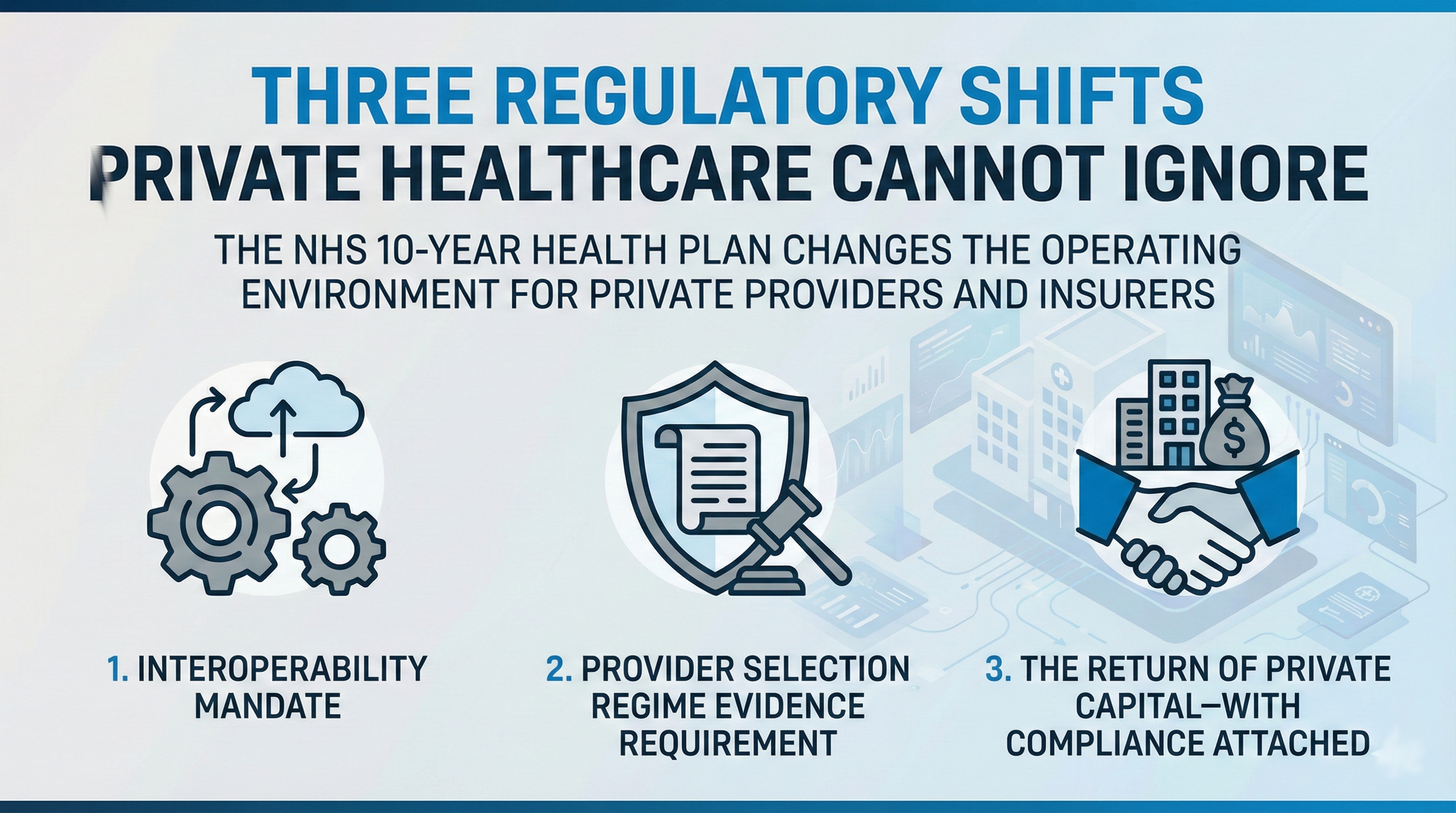
The NHS 10-Year Health Plan isn't just a policy document for the public sector. It rewrites the rules for private providers and insurers operating in the UK healthcare market. Three regulatory shifts, in particular, will reshape how private healthcare operates, competes, and demonstrates value.
Ignore them, and you risk being locked out of NHS partnerships, losing competitive advantage, or facing compliance gaps that erode trust with patients and commissioners alike.
1The Interoperability Mandate
The plan commits to complete digitisation of the NHS by 2030, with interoperability at its core. Every organisation that touches NHS patient pathways will need to exchange data in standardised formats, primarily FHIR.
For private providers, this means:
- Technical readiness becomes a market entry requirement. If your systems cannot send and receive FHIR resources, you cannot participate in NHS-funded pathways.
- Data governance scales in complexity. Interoperability brings obligations: consent management, provenance tracking, and audit trails that span organisational boundaries.
- Investment timelines compress. Waiting to see how the NHS implements interoperability is no longer a viable strategy. By the time standards crystallise, compliant competitors will have secured partnerships.
2Provider Selection Regime Evidence Requirements
The Provider Selection Regime (PSR) replaced the old procurement rules in 2024, giving ICBs more flexibility in how they select healthcare providers. But flexibility comes with accountability. Commissioners must now justify their choices with evidence.
For private providers, this creates both opportunity and obligation:
- Outcome data becomes currency. Providers who can demonstrate clinical effectiveness, patient experience, and value for money gain advantage. Those who cannot produce evidence lose ground.
- Integration capability matters. PSR favours providers who can work seamlessly within local care systems. Standalone excellence is less valuable than connected performance.
- Transparency is expected. Commissioners need data they can audit and compare. Proprietary metrics and opaque reporting no longer suffice.
3The Return of Private Capital - With Compliance Attached
The NHS 10-Year Plan acknowledges that public funding alone cannot meet infrastructure and capacity demands. Private capital is returning to healthcare, but under very different terms than the PFI era.
Investors and operators should expect:
- Clinical safety requirements to apply regardless of ownership. DCB 0129 and 0160 compliance, once seen as NHS-specific, increasingly define the baseline for any digital health investment.
- ESG scrutiny to include healthcare governance. Investors face questions about clinical risk management, data protection, and health equity that go far beyond financial returns.
- Partnership models that demand operational integration. Capital that expects arm's-length returns without operational engagement will find fewer opportunities.
What This Means for Private Healthcare Leaders
These three shifts share a common thread: the boundary between public and private healthcare is becoming more porous, and the governance expectations are converging.
Private providers and insurers who treat NHS standards as optional, or as someone else's problem, will find their market position eroding. Those who invest in interoperability, evidence infrastructure, and clinical governance will find doors opening.
The question is not whether to comply, but how quickly you can build the capabilities that compliance requires.
Where to Start
For organisations assessing their readiness:
- Audit your data architecture. Can you produce FHIR-compliant data exchanges today? If not, what is your roadmap?
- Map your evidence gaps. What outcome data do you collect? Can commissioners access and verify it?
- Review clinical safety posture. Are your digital systems assessed against DCB standards? Do you have hazard logs and clinical risk management processes?
- Assess partnership readiness. Can you integrate operationally with NHS systems and pathways? What barriers exist?
The regulatory environment is shifting. Private healthcare organisations that move early will shape how these standards are implemented. Those that wait will adapt to standards set by others.