Summary
The DHSC and NHS England recently published findings from four Regional Learning Events held as part of the National Neighbourhood Health Implementation Programme (NNHIP). 940 people from 43 local place teams participated. The synthesis is remarkably candid about what's working and what isn't.
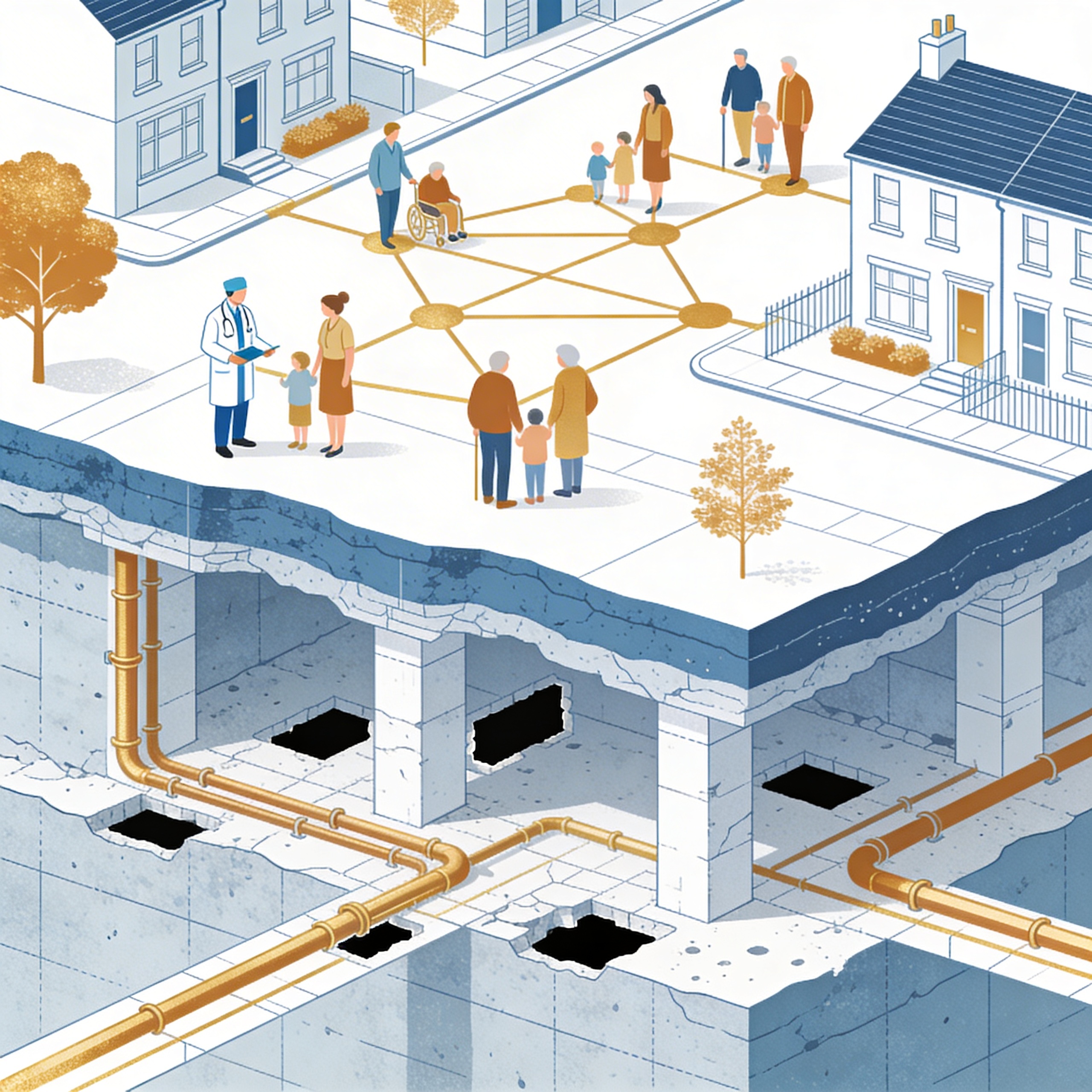
Reading it as infrastructure engineers rather than policy analysts reveals something striking: every major challenge identified — data sharing barriers, unclear accountability across organisations, fragmented governance, the inability to track outcomes across boundaries — is a symptom of the same underlying problem. The NHS is attempting inter-organisation responsibility transfer at neighbourhood scale without the governance infrastructure to support it.
This piece maps the NNHIP findings against the Seven Flows model for clinical governance infrastructure. The alignment isn't coincidental. These are the structural problems that emerge whenever multiple organisations try to share responsibility for a patient's care journey without a common infrastructure layer to guarantee safe handoffs.
What NNHIP Actually Found
The programme identified seven "key ingredients" for successful neighbourhood health. They also surfaced nine system tensions that participants described as polarities to be managed rather than problems to be solved. Both lists deserve careful reading — not for what they say, but for what they reveal about the infrastructure that's missing.
The Seven Key Ingredients
The NNHIP's seven ingredients are:
- Invest in relationships, co-design and organisational development — relationship quality matters more than the number of organisations at the table
- Build multi-agency teams, not just MDTs — move beyond traditional multi-disciplinary teams to genuine multi-agency working spanning NHS, local government and VCSE
- Back local innovation with funding and support — sustainable models require shifts in how money and resources flow
- Make data usable, shared and action-oriented for population need — population health management, segmentation and risk stratification alongside integrated datasets
- Protect workforce wellbeing and relational capacity — psychologically safe cultures to sustain staff and enable relational work
- Shift power and decision-making to neighbourhoods and communities — devolving data, insight and decision-making to place
- Lead for learning — model curiosity, safe failure and honest reflection
These are all legitimate priorities. But notice what's absent: there is no ingredient that addresses the governance mechanics of how responsibility transfers between organisations. How does a GP practice formally hand accountability for a complex patient to an Integrated Neighbourhood Team that spans three employers? What happens to clinical safety obligations when a VCSE worker identifies a risk? Who holds the audit trail when six organisations are simultaneously involved in someone's care?
The ingredients describe the culture and relationships needed for neighbourhood health. They don't describe the plumbing.
The Nine Tensions
The system tensions are even more revealing:
- Shift resources upstream AND remain accountable for acute demand
- Deliver operational priorities WHILE investing in people, trust and relationships
- Give neighbourhoods genuine autonomy AND meet national requirements
- Use formal system power AND grow community and VCSE power
- Clinical outcomes and system efficiencies AND what matters to residents
- Population health data AND relational insight from doorsteps
- Start with those "we are failing most" AND whole-population thinking
- Technical expertise AND lived experience authority
- National/ICB requirements AND local experimentation
NNHIP frames these as polarities — inherent tensions to be managed through governance and learning cycles. That framing is partially right. But several of these tensions are not philosophical polarities at all. They are engineering problems that persist because the infrastructure to resolve them doesn't exist.
Tension 1 (upstream investment vs acute accountability) is a resource allocation problem that becomes tractable when you can track outcomes across the full care pathway. Tension 3 (local autonomy vs national assurance) is a governance problem that disappears when you have infrastructure that enforces safety standards while permitting local variation. Tension 6 (population data vs relational insight) is a data architecture problem solvable through proper integration.
Treating engineering problems as philosophical tensions guarantees they remain unresolved.
The Seven Flows: Infrastructure for What NNHIP Is Describing
At Inference Clinical, we've spent the past two years building governance infrastructure specifically designed for the inter-organisation responsibility transfer problem that NNHIP is describing. The framework is called the Seven Flows, and each Flow addresses a distinct governance requirement that must be met for safe clinical handoffs across organisational boundaries.
Here's how they map to the NNHIP findings:
Flow 1: Identity — "Who's in the Gang?"
One of the most repeated phrases across the NNHIP events was the need to clarify "who's in the gang" — which professionals belong to an Integrated Neighbourhood Team, what their roles are, and how they relate to each other across employing organisations.
The Identity Flow addresses this at the infrastructure level. It's not about org charts or relationship-building workshops. It's about having a reliable, real-time way to know which practitioners are authorised to participate in a patient's care, what roles they hold, and which organisation carries their clinical governance obligations. Without this, every multi-agency huddle operates on informal knowledge and assumption.
Cornwall and the Isles of Scilly described formally aligning staff to INTs and giving teams "equal access to systems, shared spaces and consistent MDT practice." That's the right instinct. The Identity Flow makes it machine-readable and auditable.
Flow 2: Consent — The Data Sharing Barrier Nobody Wants to Engineer
NNHIP's Data & Digital enabler section calls for "shared standards and governance early" and warns that "without this foundation, digital ambition rapidly fragments." The cohort sessions identified data interoperability as a critical need, with participants wanting to know "how to navigate information governance so data can genuinely flow around a neighbourhood."
This is the Consent Flow. Not consent as a compliance checkbox, but consent as living infrastructure — a dynamic, auditable record of what a patient has agreed to, which organisations can see what, and how those permissions change as their care journey evolves. The reason data sharing barriers persist across the NHS isn't primarily technical. It's that nobody has built the consent infrastructure that would allow organisations to share data safely and demonstrably rather than either hoarding it or sharing it on informal trust.
The NNHIP presentation notes that cohorts need help with "which population health tools, shared care records and risk-stratification approaches actually help frontline teams." The answer starts with consent infrastructure that makes sharing legally defensible and clinically safe by design.
Flow 3: Provenance — Shared Records That Know Their Own History
The Cheshire & Merseyside case study describes deploying Blinx PACO across 120 GP practices to create "a single shared patient record, giving professionals and patients a complete, up-to-date view of care." This is application-layer thinking — building a platform where people can see the same data.
The Provenance Flow operates underneath this. It asks: when six organisations contribute to a shared record, which entry came from where? Which version of a care plan was the clinician working from when they made their decision? If something goes wrong, can you reconstruct the information state at the point of decision?
These aren't abstract concerns. They're DCB 0129 and DCB 0160 requirements — the clinical safety standards that apply to every health IT system deployed in the NHS. The NNHIP presentation doesn't mention clinical safety standards once in 38 slides. That's a significant gap. Multi-agency neighbourhood teams are, by definition, creating new information flows between organisations. Every one of those flows is subject to clinical safety regulation. The Provenance Flow makes compliance structural rather than procedural.
Flow 4: Clinical Intent — What the Team Is Actually Trying to Achieve
NNHIP emphasises moving from "what's the matter with you?" to "what matters to you?" — building services around the person rather than fitting people into services. The programme calls for shared objectives, shared language and shared accountability.
The Clinical Intent Flow gives this structure. When a multi-agency team agrees on a care plan, what exactly did they agree? Which goals are clinical, which are social, which are community-based? Who owns each element? What constitutes success or failure?
Without a formalised Clinical Intent Flow, multi-agency care plans exist as narrative documents in someone's notes. They can't be tracked, measured, or audited across organisations. The NNHIP cohorts specifically asked for help "establishing a small, shared set of whole-person outcomes for all partners." That's the Clinical Intent Flow — capturing what the team intends to achieve in a structured, interoperable format.
Flow 5: Alert & Responsibility — "I've Got Your Back"
The phrase "I've got your back" appears in NNHIP's closing reflections as an aspiration for team culture. Participants talked about psychological safety, normalising friction, and creating structures to navigate tensions while staying centred on shared outcomes.
The Alert & Responsibility Flow turns this sentiment into infrastructure. When a community health worker notices a deterioration in a patient's condition, what happens? Who gets notified? What's the escalation path? Who holds clinical responsibility at each stage? In a single-organisation setting, these pathways are (usually) clear. In a multi-agency Integrated Neighbourhood Team, they are not — unless you build the infrastructure to define them.
This Flow directly addresses NNHIP tension 4 (formal system power AND community/VCSE power). The infrastructure defines clear escalation paths that respect VCSE workers' observations while routing clinical decisions to appropriately qualified practitioners. It makes power-sharing safe rather than aspirational.
Flow 6: Service Routing — Getting People to the Right Support
NNHIP's case studies describe efforts to remove internal referrals and create "one team" models where patients don't fall through cracks between services. The programme calls for structures "agnostic of employer" with shared records that close gaps in the system.
The Service Routing Flow addresses the mechanics. When an Integrated Neighbourhood Team identifies a need that sits outside their capability — specialist mental health, housing support, benefits advice — how does the routing happen? Not informally through "knowing someone," but through infrastructure that understands service availability, eligibility criteria, and capacity.
This is particularly relevant to the NNHIP emphasis on VCSE integration. Voluntary sector organisations often operate outside the NHS digital ecosystem entirely. Service Routing infrastructure that spans NHS, local authority and VCSE providers is essential for the neighbourhood model to function at scale.
Flow 7: Outcome — Tracking What Actually Happened
The NNHIP programme repeatedly calls for better outcome tracking: "use early-stage evaluation and data-led continuous learning to refine the model and demonstrate real benefits." The funding enabler section emphasises tracking "broader value (quality of life, equity, carer experience, community capacity, economic impact) alongside financial metrics."
The Outcome Flow closes the loop. It captures what happened — not in a retrospective evaluation months later, but as a continuous record that feeds back into all the other Flows. Did the care plan achieve its intended goals? Did the alerting work? Did services respond? Did the patient's situation improve?
This is where the "learning system" that NNHIP aspires to becomes technically possible. You cannot build rapid feedback loops from narrative case notes scattered across six organisations' separate systems. You need structured outcome data flowing through common infrastructure.
The Case Study Gap: Application Thinking vs Infrastructure Thinking
Two NNHIP case studies illustrate the difference between solving problems at the application layer versus the infrastructure layer.
Cheshire & Merseyside: Blinx PACO
The Blinx PACO deployment across 120 GP practices represents genuine progress. A shared platform for caseloads, care plans, tasks, prescriptions, consultations, and remote monitoring is a meaningful step toward integrated working.
But the description reveals an infrastructure gap. PACO "integrates with organisational EPRs" — it sits alongside existing systems rather than replacing them. This means clinical safety obligations still follow organisational lines. If a community nurse in Organisation A updates a care plan on PACO that a GP in Organisation B acts upon, which organisation's clinical safety case covers that interaction? PACO provides the application. The governance infrastructure for inter-organisation safety assurance is not addressed.
The NNHIP report describes PACO's approach as mirroring "the national pioneer model: define a core digital capability, enable local flexibility, and improve interoperability in the short term while building a coherent long-term architecture." That long-term architecture is the infrastructure layer — and it cannot be deferred indefinitely without clinical safety risk.
South & West Hertfordshire: Community Transformation Fund
The social finance model in South & West Hertfordshire is innovative: repayable grants for proactive care, non-repayable grants for VCSE capacity, and a local CIC to recycle investment. This addresses the funding challenge directly.
But the care model — identifying high-risk residents through data, offering Comprehensive Geriatric Assessments, and providing multi-agency wraparound care — creates exactly the inter-organisation responsibility transfer problem that requires infrastructure to solve. When a dedicated multi-agency team provides "goal-based care" linking specialist services and VCSE, every one of the Seven Flows is in play. Identity (who's in the team), Consent (data sharing for risk stratification), Provenance (whose assessment is this), Clinical Intent (what are the goals), Alert & Responsibility (who escalates what), Service Routing (connecting to specialists and VCSE), and Outcome (did it work).
The financial innovation is real. The governance infrastructure to make the clinical model safe at scale is not yet in place.
What "Compliance as Infrastructure" Means in Practice
The NNHIP findings describe a system where clinical governance is treated as overhead — something that slows teams down, creates bureaucracy, and needs to be minimised so the real work can happen. The programme calls for "dissolving bureaucracy" and "enabling finance, digital and estates that enable different ways of working."
We agree that bureaucratic governance is a problem. But the solution isn't less governance — it's better-engineered governance. Compliance as infrastructure means building the safety guarantees into the platform layer so that teams can work fluidly across organisational boundaries without worrying about whether they're meeting their DCB 0129 obligations. The compliance happens structurally, not procedurally.
Consider the analogy of HTTPS. Nobody thinks about TLS certificates when they browse the web. The security infrastructure is invisible — built into the platform layer so that application developers and end users don't have to think about it. That's what clinical governance infrastructure should look like for neighbourhood health: invisible to the practitioner, rigorous in its guarantees, auditable when needed.
NNHIP's aspiration that "things move at the pace of trust" is exactly right. But trust can be engineered as well as earned. When organisations can demonstrate — through infrastructure — that data sharing is lawful, that responsibility transfer is auditable, and that clinical safety obligations are met, trust accelerates. You don't need three years of relationship-building before you can share a care plan safely. You need infrastructure that makes sharing safe by design.
The Mindset Shifts That Need Infrastructure
The NNHIP presentation includes a compelling "From/To" table of mindset shifts needed for neighbourhood health. Several of these shifts are impossible without infrastructure:
| NNHIP Mindset Shift | Infrastructure Requirement |
|---|---|
| Rigid professional boundaries → mixed teams focused on skills and neighbourhoods | Identity Flow: machine-readable team composition across employers |
| Focusing on activity and outputs → outcomes that matter to residents | Outcome Flow: structured outcome data flowing across organisational boundaries |
| Short-term projects → long-term place-based commitments | Provenance Flow: persistent audit trails that survive organisational restructures |
| Slow bureaucratic decisions → agile enabling approaches | All Seven Flows: compliance embedded in infrastructure so process overhead vanishes |
| Designing for communities → co-producing with communities | Consent Flow: dynamic consent that empowers patients and communities |
The cultural shifts are necessary. But culture alone doesn't create the technical conditions for multi-agency working at scale. You need both: the relationships AND the plumbing.
What Comes Next
The NNHIP programme represents the most significant articulation of NHS neighbourhood health ambition to date. 940 people across 43 place teams are describing — with remarkable consistency — the same structural gaps.
At Inference Clinical, we've built the infrastructure layer that these teams are describing the absence of. The Seven Flows framework provides constitutional guarantees for safe clinical handoffs across organisational boundaries. It doesn't replace the relationship-building, the co-design, or the community engagement that NNHIP rightly prioritises. It provides the governance substrate on which all of that can operate safely at scale.
The programme's own data tells the story. Cohorts need help with data interoperability, commissioning and funding flows, scale and spread, and moving beyond single-condition thinking. These are infrastructure problems. They deserve infrastructure solutions.
We'd welcome the opportunity to explore this with any of the 43 place teams, the NNHIP national team, or anyone working on the governance architecture for neighbourhood health. The problems are clear. The infrastructure exists. The question is whether the system is ready to treat governance as engineering rather than bureaucracy.