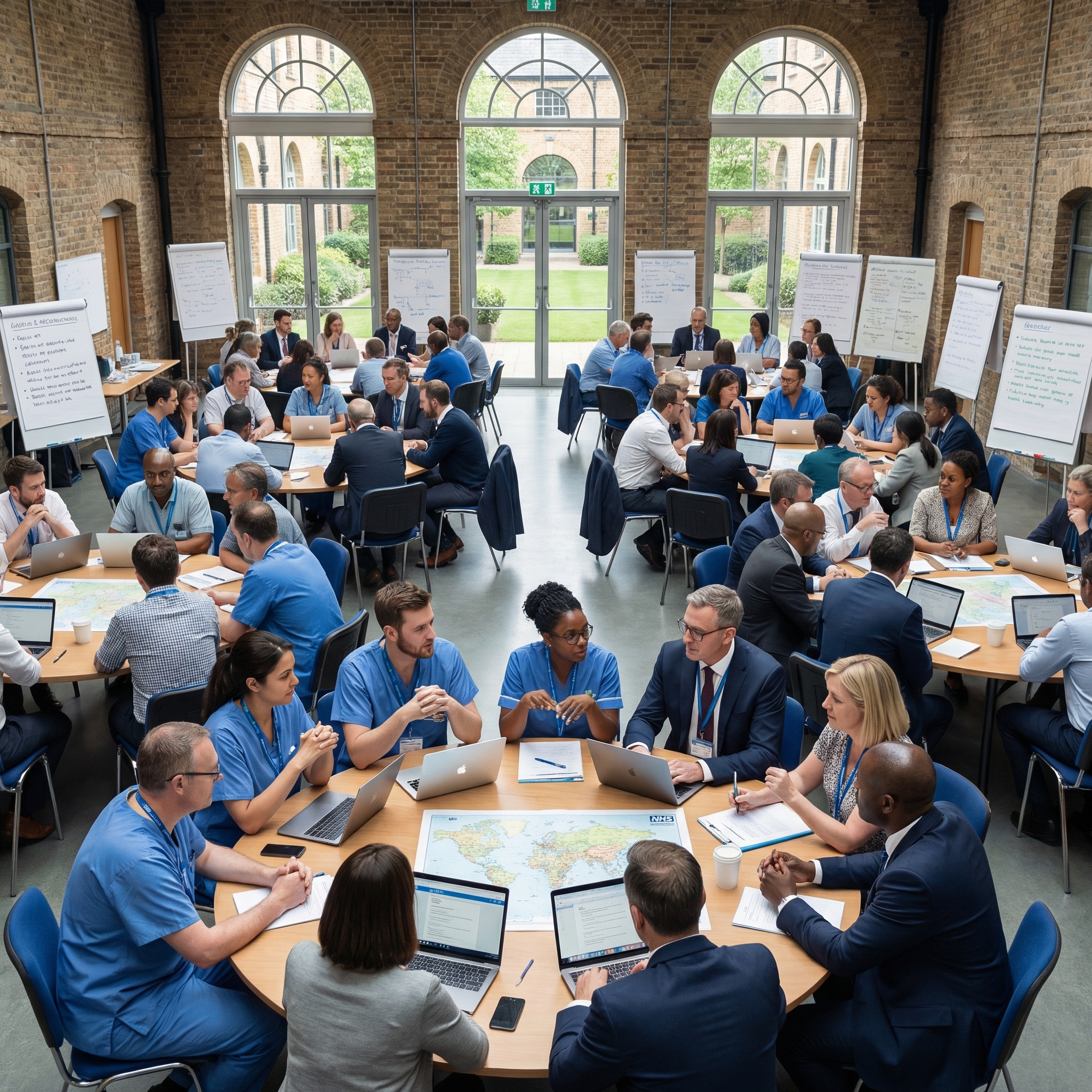
In November last year, PPL brought together 100 participants from across health and care for the first ever national simulation of neighbourhood health in action. I took part, playing the role of a resident. What I experienced confirmed something I had long suspected. The neighbourhood health model works, but its sustainability depends on infrastructure that does not yet exist.
Inside the PPL National Neighbourhood Health Simulation
I played a Colombian man living in England, suffering respiratory problems from working long hours in a poorly paid cleaning job. I was tired, unwell, stressed, and finding life in England much harder than I had expected. My daughter in the simulation was a 13-year-old girl who only wanted to help her Dad. She was played brilliantly by a fellow participant who in real life is a highly experienced paediatric nurse. But her Dad was absent. Stressed. Unwell. Emotionally unavailable.
As the simulation unfolded over several days, services tried to wrap around our family. At times, the activation of those services genuinely provided the support our model family needed. Health issues were addressed. My daughter's character was being bullied at school, and that was picked up. Specific needs were met by specific professionals. The model was working, on its own terms.
But context was absent.
My character's absence and emotional distance had created a void in my daughter's life. A void that was being filled by an older man she had met online.
Despite making this increasingly obvious as the simulation progressed, the safeguarding issue was not discovered. At times, certain professionals arrived and I could not quite identify the relevance of their conversation to what was actually happening in our family. Each service saw its piece. Nobody saw the whole.
My fellow participant and I could see it. The professionals around us could not. Not because they lacked skill or intent, but because the information and context needed to join the dots was fragmented across the different services involved.
Why Co-location Fails: The Safeguarding Blind Spot
This is not a criticism of the simulation. Flushing out exactly these kinds of issues is what simulations are designed to do. The full report from PPL sets out results that speak for themselves: outpatient appointments fell by 25 per cent, unplanned admissions dropped by 14 per cent, GP appointments reduced by 11 per cent. An annualised £78 million of A&E attendances and non-elective admissions were avoided. Over 2,300 residents were supported back into the workforce. Referrals dropped because professionals were working as a single team around residents rather than passing them between organisations.
The neighbourhood health model works. PPL, NHS Providers, Optum and Feedback Medical should be recognised for creating a space where that could be experienced and evidenced.
But what our family's story exposed is the gap between activating services and understanding context. Multiple professionals engaged with us. Each addressed the issue in front of them. But the pattern required someone, or something, to hold the whole picture across every touchpoint. A father withdrawing. A child becoming vulnerable. A predatory relationship forming. These were not separate issues, and recognising that required visibility across all the services involved.
In the simulation, this gap existed despite everyone being in the same building, operating with shared purpose and goodwill. The question that stayed with me was: what happens when this operates at scale, every day, across distributed teams, with staff turnover, under pressure, and without everyone in the same room?
NHS Boundary Risks & Clinical Responsibility
At Inference Clinical, we have spent considerable time examining where care pathways break down. The pattern is consistent: boundary failures rarely begin with clinical error. They begin with uncertainty about responsibility and the fragmentation of context.
Commissioners, providers and system leaders operate within a dense statutory framework. This spans the Care Act 2014, the Mental Capacity Act, human rights obligations, equality duties, safeguarding, financial propriety and market sustainability. These duties do not pause when care crosses an organisational border. They persist across referrals, placements, discharges and handovers.
What changes at transition points is not the duty but the clarity of who holds it, the completeness of the information that accompanies it, and the continuity of accountability.
This is not a failure of professional intent. It is a structural reality of multi-organisational care. And neighbourhood health, for all its promise, increases the number of transition points rather than reducing them. Each new service that wraps around a family creates another boundary. Another point where context can be lost. Another moment where a signal can fall between the seams. A child's growing vulnerability, for example.
The LSPPT Framework for Neighbourhood Health Governance
The simulation demonstrated what is possible. The question now is how to move from a controlled environment to sustained, safe operation. That transition cannot be improvised. It requires a structured, sequential approach. One that resists the temptation to jump straight to technology and instead builds from foundations that will hold under pressure.
At Inference Clinical, we describe this sequence as five disciplines: Legal, Safety, People, Choreography, and Technology. The order is deliberate. Each discipline depends on the one before it. Skip a step, and what you build will not hold.
Legal basis
The starting point is the legal framework within which neighbourhood health must operate. The Care Act 2014, the Mental Capacity Act, human rights obligations, equality duties, safeguarding legislation, financial propriety requirements and subsidy control are not background context. They are binding constraints that define what every boundary crossing must achieve.
Until the legal duties active at every transition point are explicit, everything that follows is guesswork. Who owes what to whom, under which statute, at which moment. These questions must be answered before anything else can proceed.
Safety basis
With the legal foundation mapped, the next discipline is clinical safety. This must be understood from the perspective of every actor in the supply chain, not just the clinicians.
Consider the range of professionals who wrapped around our simulated family. GPs addressing my respiratory problems. Social workers assessing my daughter's welfare. Social prescribers connecting us to community support. Care co-ordinators trying to hold the threads together. In a fully realised neighbourhood model, that list extends further to include psychologists, pharmacists, DWP actors assessing fitness for work and school welfare teams.
Each operates within their own regulatory framework, their own clinical safety obligations, their own organisational governance. A GP's duty of care is shaped by GMC standards. A social worker's safeguarding responsibilities sit within the Care Act and local authority protocols. A pharmacist's clinical safety obligations are governed by the GPhC. A DWP actor's engagement is framed by entirely different legislation. A social prescriber may not be a registered clinician at all, yet occupies a critical position in the pathway.
When these professionals work in a single team around a family, the safety landscape does not simplify. It compounds. The safety case for neighbourhood health must be built from every one of these perspectives. Not as a retrospective assurance exercise, but as a design constraint that shapes how the service operates.
People
The behavioural dimension follows. Neighbourhood health depends on professionals from different organisations, cultures and regulatory traditions working together around a person. That is a profoundly human challenge. Trust must be built across institutional boundaries. Professional identities and hierarchies must be navigated. Communication patterns must adapt to shared working rather than referral-based handoff.
The simulation showed this vividly. The relational energy in the room was real and powerful. Professionals were willing to work differently. But willingness is not the same as readiness, and the conditions of a simulation do not replicate automatically in sustained operation. Shared purpose, shared space and shared momentum were present in the room. They cannot be assumed at scale. The people dimension must be designed for, not assumed.
Choreography
Choreography is the discipline that most distinguishes structured boundary governance from conventional process design. It is the bilateral coordination of what must be true on the sending side for the receiving side to accept the handover.
In conventional process design, a referral is complete when it is sent. In choreography, nothing is complete until both sides confirm. A discharge summary is not sent when the hospital generates it. It is sent when the receiving practice has received it, verified the patient identity, and confirmed acceptance of clinical responsibility.
Three characteristics define choreography. First, bilateral specification. Every step has a sending requirement and a receiving requirement. Second, state visibility. At every point in the crossing, both organisations can see where the handover stands. Third, failure as a governed condition. If the receiving side does not accept, if identity cannot be confirmed, if clinical intent is queried, the crossing does not silently degrade. It stops, signals, and routes to resolution.
This is the discipline that prevents the most dangerous assumption in healthcare: that sending information is the same as transferring responsibility. In our simulation, information was sent. Services were activated. But responsibility for the whole picture was never explicitly accepted by anyone. Nobody was accountable for joining the dots between a father's illness, a child's vulnerability and a predatory relationship.
Technology as the final deliverable
Technology is the last discipline because it is instrumental, not constitutional. Technology does not define what the boundary must do. Legal and Safety define that. Technology does not define who is responsible. People define that. Technology does not define the bilateral coordination protocol. Choreography defines that.
Technology makes the other four disciplines operational at scale. It is essential, but it is the last thing you build, not the first.
Minimum Viable Responsibility Transfer
Our response to this challenge is what we call Minimum Viable Responsibility Transfer. It is a pragmatic way of making the acceptance of responsibility visible without adding bureaucratic burden.
Safe handover is not simply the transfer of information or the acceptance of a referral. It is the explicit, time-bounded acceptance of responsibility under defined conditions. It reflects what professionals already do, ensuring someone has taken responsibility, but expresses it in a form that can be evidenced, audited and trusted across organisational boundaries.
Critically, it also requires that context travels with the person. Not just clinical information about the presenting issue, but the broader picture that allows each professional to understand what they are stepping into. In our simulation, every individual service interaction was competent. What was missing was the connective tissue. The shared awareness that would have allowed someone to see that a father's respiratory illness, his emotional withdrawal, his daughter's distress and her online relationship were not separate issues but a single, escalating safeguarding risk.
Building Healthcare Boundary Infrastructure
What comes next requires a different kind of investment. Not in more platforms or dashboards, but in the governance infrastructure that makes responsibility and context visible at the seams. These are the points where duties remain constant but operational accountability becomes vulnerable.
At Inference Clinical, we are building that infrastructure. Our work focuses on making the boundaries between organisations safe, auditable and legally defensible. We map real pathways, identify where responsibility diverges from information and decision authority, and align technology to support continuity within existing workflows rather than reshape them.
The starting point is our Boundary Risk Assessment. It is a structured audit of the points where statutory duties persist but responsibility, context and acceptance may become fragmented. It makes the seams visible so that organisations can govern them, rather than discover them after something goes wrong.
The neighbourhood health model works. The simulation proved it. But the simulation also showed what happens when context fragments across well-intentioned services. A child became vulnerable, and the system, despite its best efforts, did not see it.
The task now is to build the infrastructure that allows neighbourhood health to work safely, sustainably and at scale. Not by adding complexity, but by ensuring that responsibility, context and accountability remain visible at every boundary.
Organisations do not need more complexity. They need better visibility at the seams.
The PPL National Health Simulation report is available at ppl.org.uk. Julian Bradder is the Founder and CEO of Inference Clinical Ltd.