Key Takeaways
- Every flow must cross not just an organisational boundary but a constitutional domain boundary — different legislation, funding, data architecture, and accountability on each side
- Identity: NHS number vs LA client ID with no bidirectional lookup — GP Connect is one-way, and most unplanned crossings reconcile identity manually
- Consent transforms at every crossing — from one controller’s public task to another’s — but infrastructure rarely records this transformation and individuals are rarely informed
- The gap between Level 2 (process) and Level 3 (infrastructure) is the critical threshold — Level 2 is lost when people leave or organisations reorganise; Level 3 is what survives
- Outcome flows are almost universally Level 0 — the boundary is a one-way mirror, making all other failures invisible because neither side knows what happened after the crossing
This is the seventh article in a series examining the boundary between local authority social care and the NHS. The first article established the constitutional domain gap. The second examined simultaneous reorganisation. The third quantified the cost of delayed discharge. The fourth revealed data infrastructure asymmetry. The fifth showed why neighbourhood health depends on boundary governance. The sixth examined why every accountability mechanism finds the same failures without building infrastructure. This article applies the Seven Flows methodology to the LA–NHS boundary in full — the most complex crossing in English public services.
The previous six articles in this series have built a cumulative picture. The LA–NHS boundary is a constitutional domain gap, not an administrative seam. It is being destabilised by simultaneous reorganisation on both sides. It costs £2.6 billion a year in delayed discharge alone. It has asymmetric data infrastructure with no governed interoperability. Neighbourhood health depends on it working continuously. And every accountability mechanism — from Safeguarding Adult Reviews to CQC assessments — finds the same failures without building the infrastructure to prevent them.
This article takes a different approach. Rather than describing what goes wrong, it describes what governed infrastructure requires — flow by flow, at this specific boundary, with the legal, operational, and technical conditions that make each flow both essential and uniquely difficult.
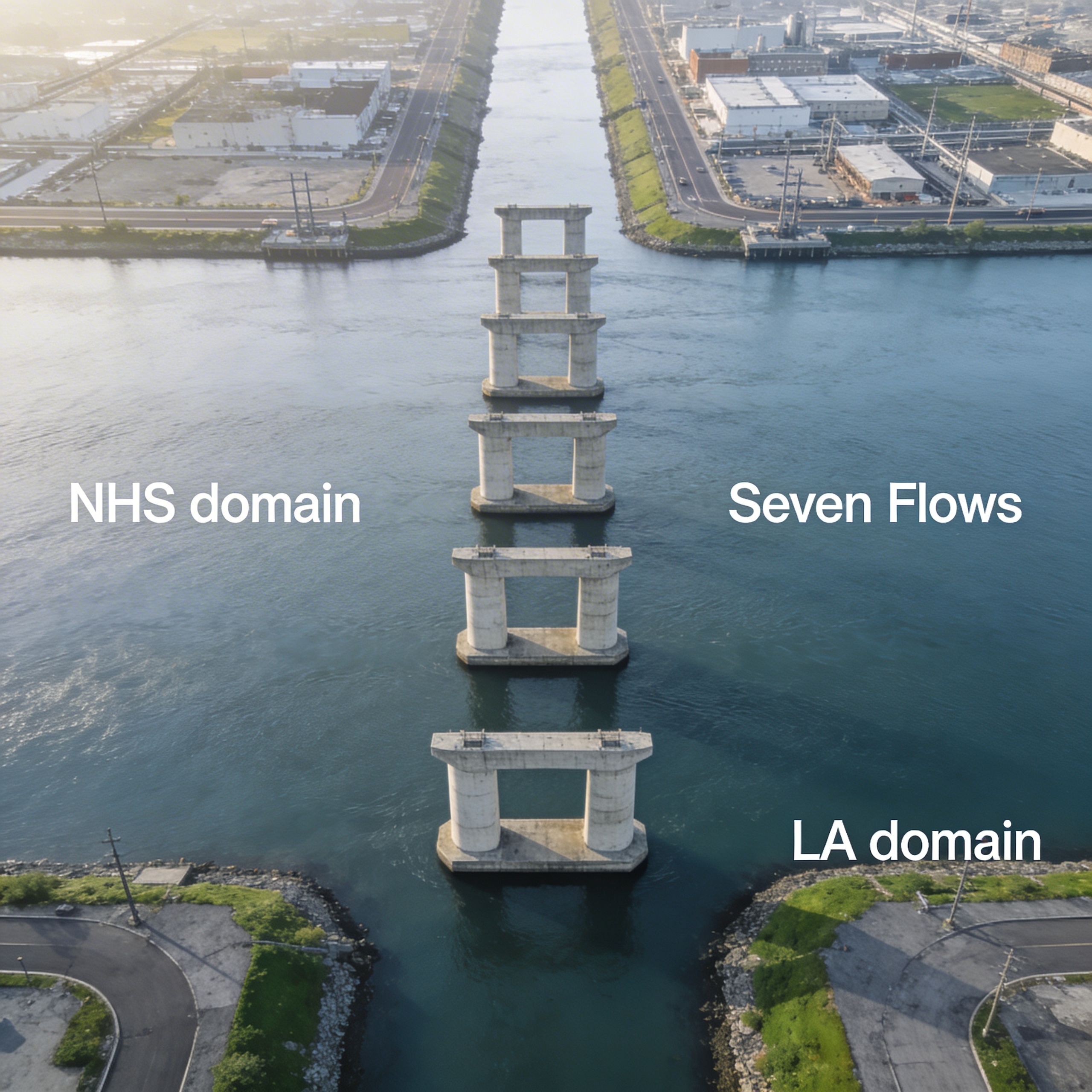
The Seven Flows framework — Identity, Consent, Provenance, Clinical Intent, Alert and Responsibility, Service Routing, and Outcome — defines the minimum conditions for any organisational boundary crossing in healthcare. At most boundaries, these flows operate within a single constitutional domain. A hospital-to-community trust handoff is complex, but both organisations operate under the NHS Act, use the NHS number, share FHIR infrastructure, and are subject to the same regulatory framework. The flows are difficult but the constitutional substrate is the same on both sides.
At the LA–NHS boundary, the constitutional substrate changes. Every flow must cross not just an organisational boundary but a domain boundary — from one legislative framework to another, from one funding model to another, from one data architecture to another, from one accountability regime to another. This is what makes the LA–NHS crossing unique, and what makes the Seven Flows methodology essential for understanding what governed infrastructure must do here that it does not need to do elsewhere.
Flow 1: Identity — NHS Number vs LA Client ID
The problem: The NHS uses the NHS number as its universal patient identifier. Mandated by law since 2015 for all health and social care organisations sharing information for direct care, the NHS number is supported by the Personal Demographics Service, the national patient database. Every NHS interaction — from GP registration to hospital admission to community nursing — is indexed to this number. It is the backbone of clinical identity in England.
Local authorities use their own client identifiers. Each of the 153 authorities with adult social care responsibilities assigns its own reference number through its own case management system. The Client Level Data collection, mandatory since April 2023, requires local authorities to submit records to NHS England quarterly. At the national analytics level, the NHS number is used to pseudonymise and link these records with health data. But at the operational level — the individual crossing where a discharge coordinator needs to find a patient’s social care record, or a social worker needs to access a patient’s clinical history — identity reconciliation remains manual.
GP Connect requires the NHS number plus date of birth to look up a patient’s record. Social care workers using an assured Digital Social Care Record can access the last three GP encounters, current medications, and allergies — but only if they know the NHS number. The reverse does not exist. An NHS discharge coordinator cannot look up a patient’s social care record using the NHS number, because social care systems are not indexed to it at the operational level.
What governed infrastructure requires: A shared identity layer at the boundary that enables bidirectional lookup — NHS number to LA client ID and LA client ID to NHS number — with audit trail, access controls, and provenance tracking. Not a single merged identity, which would raise governance questions about cross-domain data aggregation, but a governed cross-reference that operates at the point of crossing with explicit purpose limitation and consent infrastructure.
Maturity indicators
Level 0 — No cross-referencing. Identity reconciliation is manual (phone calls, searching by name and date of birth). This is where most LA–NHS crossings currently operate for unplanned interactions.
Level 1 — NHS number is recorded in the social care system for some service users, but inconsistently and without automated lookup. Cross-referencing depends on individual staff effort.
Level 2 — NHS number is systematically recorded for service users in contact with both systems. GP Connect provides one-way clinical data access. But no reverse lookup exists, no audit trail tracks cross-domain identity use, and identity reconciliation at unplanned crossings (such as safeguarding alerts or emergency discharge) remains manual.
Level 3 — Bidirectional cross-reference operates at the boundary with purpose-limited access controls. Identity reconciliation is automated for planned crossings (discharge, CHC assessment, care planning) and rapid for unplanned crossings (safeguarding, clinical escalation). Audit trail records every cross-domain identity lookup.
Level 4 — Shared identity layer is governed infrastructure, surviving organisational change. Cross-reference is maintained as a boundary service rather than within either organisation’s systems. Constitutional binding ensures each domain’s data remains governed by its originating authority even when accessed through the cross-reference.
Flow 2: Consent — Lawful Basis Transformation at Every Crossing
The problem: Consent is not a single act at the LA–NHS boundary. It is a transformation. On the NHS side, the lawful basis for processing personal data is typically Article 6(1)(e) UK GDPR — processing necessary for the performance of a task carried out in the public interest. This is a broad basis, built into the architecture of universal healthcare: the NHS processes your data because providing your healthcare is a public task.
On the local authority side, the lawful basis for adult social care also relies on Article 6(1)(e) — but for the local authority’s own public task under the Care Act 2014, not the NHS’s public task. The Data Use and Access Act 2025 clarified this distinction: Article 6(1)(e) processing is the controller’s own task, not another body’s. A local authority cannot process health data by relying on the NHS’s public task, and vice versa.
This means that at every crossing, the lawful basis for processing the person’s data changes. When clinical information travels from an NHS trust to a local authority for a Care Act assessment, it moves from one controller to another, from one public task to another. The individual is rarely informed that this transformation has occurred, and rarer still understands that their data — created for the purpose of clinical care under the NHS Act — is now being processed for eligibility determination under the Care Act, potentially including means-testing of their financial assets.
For special category data (health data under Article 9 UK GDPR), the NHS relies on Article 9(2)(h) — processing necessary for health or social care purposes. Local authorities rely on the same provision but with a different statutory context: processing under the Care Act rather than the NHS Act. For safeguarding, both sides can rely on Article 6(1)(e) and Article 9(2)(g) — substantial public interest — but the Care Act Section 42 enquiry duty belongs to the local authority, and the information sharing frameworks (Section 45) are structured around the Safeguarding Adults Board’s power to demand information, not around governed cross-domain sharing infrastructure.
What governed infrastructure requires: Consent transformation infrastructure at the boundary — not a single consent form, but a governed mechanism that records the change in lawful basis, the change in controller, the change in purpose, and the constraints that follow. When data created under NHS Act authority crosses to a local authority operating under Care Act authority, the consent infrastructure must record that crossing, apply the constraints of the originating authority, and ensure that the receiving authority processes the data only for purposes consistent with both the original and the new lawful basis.
Maturity indicators
Level 0 — No explicit consent transformation. Data crosses the boundary without recording the change in lawful basis or controller. The individual is not informed.
Level 1 — Generic information-sharing agreements exist between the NHS organisation and the local authority. Consent is addressed in policy but not at the point of crossing.
Level 2 — Consent is obtained or recorded for specific planned crossings (CHC assessment, joint care planning). But it is treated as a one-time event rather than a transformation. The change in lawful basis is not made explicit to the individual or in the data record.
Level 3 — Consent transformation is recorded at each crossing. The data record carries the lawful basis under which it was created and the lawful basis under which it is being processed by the receiving controller. Purpose limitation constraints travel with the data. The individual can understand, if they ask, what happened to their consent when their data crossed the boundary.
Level 4 — Consent infrastructure is governed at the boundary, applying constitutional binding to every data element. Purpose limitation is enforced technically, not just procedurally. Audit trail records every consent transformation, every change in controller, every purpose limitation applied — and this infrastructure survives organisational change.
Flow 3: Provenance — Constitutional Binding for Cross-Domain Data
The problem: Clinical data and social care data are created under different professional frameworks, recorded in different formats, stored in different systems, and governed by different retention and access regimes. When data crosses the LA–NHS boundary, its provenance — who created it, under what authority, for what purpose, and with what constraints — is typically lost.
The NHS records clinical information in structured formats: SNOMED CT for clinical terminology, FHIR for data exchange, Transfer of Care standards for discharge summaries. These are national standards, mandated by NHS England, supported by national infrastructure. A hospital discharge summary has a defined structure, coded diagnoses, and traceable provenance.
Social care records use different terminology, different structures, and different levels of standardisation. The Digital Social Care Records programme has achieved 80% adoption, but the records themselves are structured around Care Act assessment frameworks rather than clinical terminology. A social care needs assessment describes the person’s eligible needs under Section 13 of the Care Act, their outcomes under Section 1 (wellbeing principle), and their care and support plan under Section 25. It does not use SNOMED CT. It is not structured in FHIR. It describes the same person as the clinical record, but in a fundamentally different language.
When clinical reasoning crosses the boundary — in a discharge summary, a CHC referral, a safeguarding alert — it is compressed. A clinician’s assessment of a patient’s cognitive function, documented in structured clinical terms with coded observations, becomes a narrative paragraph in a social care referral. The provenance of each clinical observation — who observed it, when, under what conditions, with what clinical significance — is stripped in translation. The receiving social care professional gets a summary, not a governed data transfer.
What governed infrastructure requires: Provenance tracking that survives the crossing. Every data element that crosses the LA–NHS boundary must carry: who created it, under what professional authority, for what purpose, in what system, with what clinical or social care significance, and with what constraints on onward use. This is the constitutional binding requirement — every piece of data must be explicitly bound to the constitutional authority under which it was created, and that binding must travel with the data and constrain what happens next.
Maturity indicators
Level 0 — No provenance tracking across the boundary. Data is transcribed manually between systems. Original context is lost.
Level 1 — Documents (discharge summaries, referral letters) cross the boundary as attachments. The document preserves some provenance (author, date, organisation) but not the structured data within it.
Level 2 — Structured data crosses the boundary for specific use cases (GP Connect provides read-only access to coded clinical data). But the provenance of each data element is not tracked once it is recorded in the receiving system.
Level 3 — Provenance metadata travels with data across the boundary. Each data element carries its origin (organisation, professional, system), its constitutional authority (NHS Act or Care Act), its purpose limitation, and its retention requirements. The receiving system can distinguish between data created under clinical authority and data created under social care authority.
Level 4 — Constitutional binding is enforced at the infrastructure level. Data created under NHS Act authority can be viewed by social care professionals through governed access but remains governed by its originating framework. Provenance is auditable, traceable, and survives organisational change.
Flow 4: Clinical Intent — Bolam vs Wednesbury at the Boundary
The problem: Clinical intent — the reasoning behind decisions about a person’s care — is expressed differently on each side of the boundary, and the crossing between them has no governed mechanism for translation, reconciliation, or conflict resolution.
On the NHS side, clinical intent is expressed through clinical assessment, diagnosis, treatment planning, and ongoing management. A clinician’s intent for a patient with multiple long-term conditions is documented in clinical terms: medication management goals, therapy targets, disease progression monitoring, risk stratification. The professional framework is clinical — governed by Bolam (reasonable professional practice), GMC/NMC standards, and NICE guidelines.
On the local authority side, intent is expressed through Care Act assessment: the person’s eligible needs, their desired outcomes, their wellbeing under the Section 1 principle. The professional framework is social work — governed by Wednesbury reasonableness (administrative law), Social Work England standards, and the Making Safeguarding Personal approach. A social worker’s intent for the same person is documented in terms of independence, dignity, participation, and protection — not clinical metrics.
At the boundary, these two expressions of intent must be reconciled. A hospital clinician’s discharge plan says the patient needs twice-daily medication administration, weekly wound dressing, and daily monitoring for cognitive deterioration. The local authority’s care plan says the person needs support with personal care, a safe home environment, and social participation. Both are describing care for the same person. Neither maps cleanly onto the other. And when they conflict — when the clinical plan requires a level of monitoring that the social care package does not include, or when the social care plan prioritises independence in ways that the clinician considers clinically risky — there is no governed mechanism for resolving the conflict.
In neighbourhood health, this problem is continuous. A multi-disciplinary team includes clinicians and social care professionals making joint decisions about a person’s care. But the joint care plan has no governed framework for recording which elements are clinically governed (NHS Act authority) and which are socially governed (Care Act authority). When something goes wrong, accountability depends on unpicking the plan to determine which domain each decision fell under — a retrospective exercise in provenance reconstruction.
What governed infrastructure requires: Cross-domain care planning infrastructure that records clinical intent and social care intent as parallel but distinct elements, with explicit governance for each. Where the two domains align, the plan records the alignment. Where they conflict, the plan records the conflict and the mechanism by which it was resolved. Each element carries constitutional binding — the professional authority under which it was created and the accountability framework that applies.
Maturity indicators
Level 0 — No cross-domain care planning. Clinical and social care plans exist separately with no governed connection.
Level 1 — Joint meetings (MDTs, discharge planning meetings) produce shared discussion but separate plans. Clinical notes record one version; social care records record another.
Level 2 — Shared care plans exist for specific crossings (discharge pathway plans, CHC care plans). But the plan does not distinguish between clinically governed and socially governed elements, and conflict resolution is informal.
Level 3 — Cross-domain care plans explicitly record which elements are governed under clinical authority and which under social care authority. Conflicts are documented and resolved through a governed mechanism. Each professional’s contribution carries their professional accountability framework.
Level 4 — Integrated care planning infrastructure operates at the boundary with constitutional binding. Intent from each domain is recorded in its native professional language, translated through governed mapping, and reconciled through explicit conflict resolution protocols. The plan is auditable — accountability for each element is traceable to the professional and the constitutional authority under which they acted.
Flow 5: Alert and Responsibility — Where Boundary Failure Causes Harm
The problem: This is the flow where boundary failure causes direct harm. When responsibility for a person’s safety must transfer across the LA–NHS boundary — in a safeguarding alert, a discharge handoff, a clinical escalation from social care to NHS, or a duty-of-care transfer during a CHC assessment — the transfer is almost always implicit.
The second national analysis of Safeguarding Adult Reviews found poor coordination in 72% of cases and information-sharing failures in 70%. The underlying mechanism is the same in almost every case: responsibility transferred across the boundary without explicit acknowledgement, without a timestamp, and without evidence that the receiving organisation understood and accepted what was being transferred.
Consider the safeguarding pathway. An NHS professional — a community nurse, a hospital doctor, a pharmacist — identifies a concern about an adult with care and support needs. Under Section 42 of the Care Act, the local authority is the lead agency for safeguarding enquiries. The NHS professional must cross the constitutional boundary to alert the local authority.
What infrastructure exists for this crossing? In most areas: a referral form (paper or electronic), submitted to the local authority’s safeguarding team. The form may be acknowledged within working hours. It may not be acknowledged at all. There is no governed mechanism equivalent to the aviation handoff — where the receiving controller must explicitly accept jurisdiction before the transferring controller can release it. There is no infrastructure equivalent to the payment system acknowledgement — where every transfer has a millisecond timestamp and a cryptographic receipt. The most consequential responsibility transfer in English public services operates through forms, phone calls, and “should agree local arrangements.”
At discharge, the problem is structural. The third article documented the gap: hospital clinical responsibility does not end at the point the patient leaves the building if community services have not accepted the handoff. But local authority responsibility under the Care Act does not begin until the person has been assessed as having eligible needs. In the gap between the clinical duty ending and the social care duty beginning — which, for the 12,459 people in delayed discharge beds, can last days or weeks — accountability is distributed, contested, and ungoverned.
What governed infrastructure requires: Explicit responsibility transfer protocols for every crossing type. Every transfer must answer the five MVRT questions: who is responsible now, for what, for how long, under what conditions does that responsibility escalate or end, and what evidence proves the receiving organisation understood and accepted the transfer. For safeguarding, this means governed alert infrastructure with mandatory acknowledgement, defined response times, and evidence of acceptance — not just receipt. For discharge, this means explicit handoff protocols where clinical responsibility and social care responsibility are both defined at the point of crossing, with no gap permitted.
Maturity indicators
Level 0 — Responsibility transfers are implicit. Referral forms are sent but acknowledgement is not mandatory. There is no evidence trail of acceptance.
Level 1 — Referral processes have defined timeframes for acknowledgement. But acknowledgement is procedural (we received your form) not substantive (we accept responsibility for what you have transferred).
Level 2 — Responsibility transfer is explicit for some crossing types (planned discharge has a documented handoff). But safeguarding alerts, clinical escalations from social care, and unplanned crossings remain informal.
Level 3 — All crossing types have governed responsibility transfer. Each transfer records who held responsibility, who accepted it, at what time, for what scope, and under what conditions. Gaps are flagged in real time. Escalation paths are defined and activated when transfer is not accepted within defined timeframes.
Level 4 — Responsibility transfer infrastructure operates at the boundary as a governed service. No crossing occurs without explicit bilateral acknowledgement. The system records continuous responsibility — at every moment, for every person whose care spans both domains, exactly one organisation holds explicit responsibility for each defined element of care. The infrastructure survives organisational change.
Flow 6: Service Routing — CHC and the Constitutional Determination
The problem: Service routing at the LA–NHS boundary is not a logistics problem. It is a constitutional determination. When a person needs care that spans both domains, the routing decision — which services, funded by whom, governed under which framework — is a boundary-mapping exercise conducted under conditions of financial adversity.
CHC is the most visible routing decision. As the sixth article documented, 51,981 assessments were made in 2024–25, with 80.5% rejected and eligibility varying sixfold between ICBs. But CHC is only one routing decision among many. Pathway selection at discharge — Pathway 0 (home, no support), Pathway 1 (home with support), Pathway 2 (rehabilitation or reablement), Pathway 3 (complex care assessment) — is a routing decision that determines which domain funds and governs the person’s ongoing care. Equipment provision may route through NHS community services or local authority occupational therapy depending on whether the need is classified as clinical or social. Intermediate care may be jointly funded through the Better Care Fund or routed to a single funder depending on local arrangements.
Each routing decision sits at the constitutional boundary. Each involves a determination about whether the person’s need is primarily health (NHS funded, universal, clinically governed) or primarily social care (LA funded, means-tested, Care Act governed). Each is made through negotiation between professionals operating under different institutional incentives — the NHS has a financial interest in routing to the local authority, and the local authority has a financial interest in routing to the NHS. And each routing decision has consequences for the person that go far beyond which organisation pays: it determines whether their care is free or means-tested, whether their assets are protected or consumed, whether their data is governed under NHS infrastructure or social care infrastructure.
What governed infrastructure requires: Transparent routing infrastructure at the boundary — not replacing clinical and social care judgement, but making the routing decision visible, auditable, and governed by criteria rather than negotiation. The criteria exist (the National Framework for CHC, the Care Act eligibility criteria, the discharge pathway definitions). What does not exist is infrastructure that applies them consistently, records the evidence for each routing decision, tracks the consequences, and provides the data to identify where variation is driven by genuine differences in need and where it is driven by institutional incentives.
Maturity indicators
Level 0 — Routing decisions are made through informal negotiation. No systematic recording of criteria applied, evidence weighed, or rationale for the decision.
Level 1 — Formal assessment frameworks exist (CHC Decision Support Tool, Care Act eligibility determination). Decisions are recorded but the evidence trail is incomplete and the process is experienced as adversarial.
Level 2 — Routing decisions are systematically recorded with evidence. But variation between assessors and between localities is not monitored, and the person at the centre of the decision has limited visibility into the criteria applied.
Level 3 — Routing infrastructure records every decision with the criteria applied, the evidence considered, and the rationale. Variation is monitored at local and national level. The person can see how the decision was made and on what basis. Appeal and review processes are integrated into the infrastructure rather than bolt-on complaints mechanisms.
Level 4 — Routing is governed at the boundary as infrastructure. Criteria application is consistent and auditable. Financial incentives are transparent and subject to oversight. The infrastructure identifies systemic patterns — where routing is driven by need and where it is driven by institutional behaviour — and feeds this back into policy and funding decisions. Routing infrastructure survives organisational change.
Flow 7: Outcome — The One-Way Mirror
The problem: The outcome loop does not close across the LA–NHS boundary. This is the most structurally entrenched failure of the seven, and it is the failure that makes all the others invisible.
When a hospital discharges a patient to the community, the hospital does not routinely know what happened. Did the social care package arrive? Was the person assessed? Did they deteriorate? Were they readmitted? The hospital knows if the same person reappears in A&E. It does not know why, because the data about what happened in the community — what the local authority provided, what worked, what failed — does not flow back across the boundary.
When a social worker refers a clinical concern to the GP via a social care professional’s observation, the social worker does not routinely know what happened. Was the person seen? Was the concern confirmed? Was treatment changed? The social worker may find out informally, through the next joint meeting or through the person themselves. The data does not flow back through governed infrastructure.
When a safeguarding alert crosses from the NHS to the local authority, the referring NHS professional does not routinely know the outcome of the enquiry. SCIE guidance states that local authorities should acknowledge referrals and give feedback to referrers. In practice, this is inconsistent, and when it happens, it happens through ad hoc communication rather than governed data flows.
The consequence is that the boundary is a one-way mirror. Each side can send information across it but cannot see what happened on the other side. This means that neither side can measure whether the crossing worked. Neither side can identify patterns of failure. Neither side can improve the crossing based on outcome data, because outcome data does not cross the boundary in the reverse direction.
In neighbourhood health, where crossings are continuous rather than episodic, the absence of outcome flows means that the integrated team cannot measure its own effectiveness. Did the jointly planned intervention produce better outcomes than fragmented care? Nobody knows, because the outcome data sits in separate systems on separate sides of the boundary with no governed mechanism for aggregation.
What governed infrastructure requires: Bidirectional outcome flows across the boundary. For every crossing that sends data, a referral, or a responsibility transfer from one domain to the other, the infrastructure must support a governed return flow that reports what happened. Not in real time necessarily — outcome data may emerge over weeks or months. But the infrastructure must exist, so that the crossing can be evaluated, improved, and held accountable.
Maturity indicators
Level 0 — No outcome data crosses the boundary. Each side knows only what it can observe within its own domain.
Level 1 — Outcome data is shared for specific high-profile crossings (readmission rates are reported nationally, delayed discharge is counted). But this is aggregate data, not crossing-level outcome tracking.
Level 2 — Outcome feedback exists for planned crossings (CHC review at 3 and 12 months includes outcome assessment). But it operates as a separate process, not as infrastructure that closes the loop for the original crossing.
Level 3 — Outcome data flows back across the boundary for all major crossing types. The hospital knows what happened after discharge. The social worker knows what happened after the clinical referral. The NHS professional knows the outcome of the safeguarding enquiry. Data is governed, purpose-limited, and auditable.
Level 4 — Outcome infrastructure operates at the boundary as a governed service. Every crossing generates an outcome record that flows back to the originating domain. Aggregate outcome data identifies where crossings are working and where they are failing — not just for individual cases but for the crossing as a system. This data feeds into commissioning, quality improvement, and accountability. The infrastructure survives organisational change.
The Maturity Picture: Level 2 vs Level 3
No LA–NHS crossing in England currently operates at Level 3 or above across all seven flows. Most operate at Level 0 or 1 for the majority of flows, with pockets of Level 2 for specific, well-funded crossing types — typically discharge and CHC, where the financial consequences are large enough to have generated dedicated processes.
This is not a failure of effort. The people working at this boundary — the discharge coordinators, the social workers, the CHC assessors, the safeguarding leads — work extraordinarily hard to make ungoverned crossings function. They build relationships. They learn each other’s systems. They create workarounds. They carry institutional knowledge in their heads. And when they leave, or when their organisations are reorganised, all of that effort is lost.
The maturity framework is not an assessment of people. It is an assessment of infrastructure. The question is not whether individuals are doing their best at the boundary — they are — but whether the infrastructure exists to make governed crossings reliable, consistent, auditable, and survivable across organisational change.
At Inference Clinical, the Seven Flows audit methodology assesses each flow at each crossing type within a specific LA–NHS boundary. The audit produces a maturity map — seven flows scored 0–4 across every major crossing type (discharge, CHC, safeguarding, neighbourhood care, joint care planning, clinical escalation from social care). The map identifies where infrastructure exists, where it is absent, and where informal processes are masking structural gaps.
For organisations facing local government reorganisation, the maturity map has a specific additional value: it identifies which crossings depend on relationships that will not survive reorganisation and which are supported by infrastructure that can transfer to successor organisations. The audit distinguishes between what works because the right people are currently in post and what works because the infrastructure is in place.
The gap between Level 2 and Level 3 is the most significant in the framework. Level 2 is process — defined procedures for specific crossings, operated by dedicated teams. Level 3 is infrastructure — governed mechanisms that operate at the boundary regardless of which individuals are in post, which organisations exist, or how the administrative geography is drawn. The entire history of LA–NHS integration — the decades of “integration rhetoric without meaningful change” that the NHS Confederation observed — is a history of achieving Level 2 through extraordinary effort and then losing it when the people, the organisations, or the funding arrangements change.
Level 3 is what survives. It is what the LA–NHS boundary needs. And it is what this series has been building towards.
A Boundary Risk Assessment produces the maturity map for your specific crossing — seven flows scored 0–4 across every major crossing type, identifying where infrastructure exists, where it is absent, and which crossings will survive reorganisation. The Boundary Risk Score quantifies the gap between Level 2 and Level 3, giving leadership teams a measurable baseline and a structured path to governed infrastructure.
A maturity assessment of governed infrastructure across seven flows and six major crossing types. Most crossings operate at Level 0–1. The critical threshold is between Level 2 (process) and Level 3 (infrastructure).
| Identity | Consent | Prove- nance |
Clinical Intent |
Alert & Resp. |
Service Routing |
Out- come |
|
|---|---|---|---|---|---|---|---|
| Discharge | 1 | 1 | 1 | 1 | 2 | 2 | 0 |
| CHC Assessment | 1 | 2 | 1 | 2 | 1 | 2 | 1 |
| Safeguarding | 0 | 1 | 0 | 0 | 1 | 0 | 0 |
| Neighbourhood Care | 1 | 0 | 0 | 1 | 0 | 0 | 0 |
| Joint Care Planning | 1 | 1 | 1 | 2 | 1 | 1 | 0 |
| Clinical Escalation (Social care → NHS) |
0 | 0 | 0 | 0 | 0 | 0 | 0 |
Diagram: Seven Flows maturity heatmap across six LA–NHS crossing types. Maturity levels 0–4 colour-coded from dark red (absent) to green (governed). Seven flow summary cards showing typical maturity, the core problem, and what governed infrastructure requires. The critical gap: Level 2 (process) vs Level 3 (infrastructure).
Next in the series: First-mover advantage — why organisations that build boundary governance infrastructure before reorganisation carry it into new structures, while organisations that wait will rebuild from scratch.
The LA–NHS Constitutional Boundary Series
- #1 The Most Complex Boundary in English Healthcare
- #2 The Great Reorganisation: Every Boundary Redrawn at Once
- #3 Delayed Discharge: An Interface Problem, Not a Capacity Problem
- #4 The Data Governance Chasm
- #5 Neighbourhood Health Cannot Work Without Boundary Governance
- #6 Safeguarding, CHC and the Accountability Gap
- #7 Seven Flows at the LA–NHS Boundary (this article)
- #8 Building Before the Reorganisation
Related Series
- Architecting Neighbourhood Health — 10 articles on boundary governance in NHS neighbourhood teams
- Private Healthcare Governance — 8 articles on the ungoverned crossings in insured care