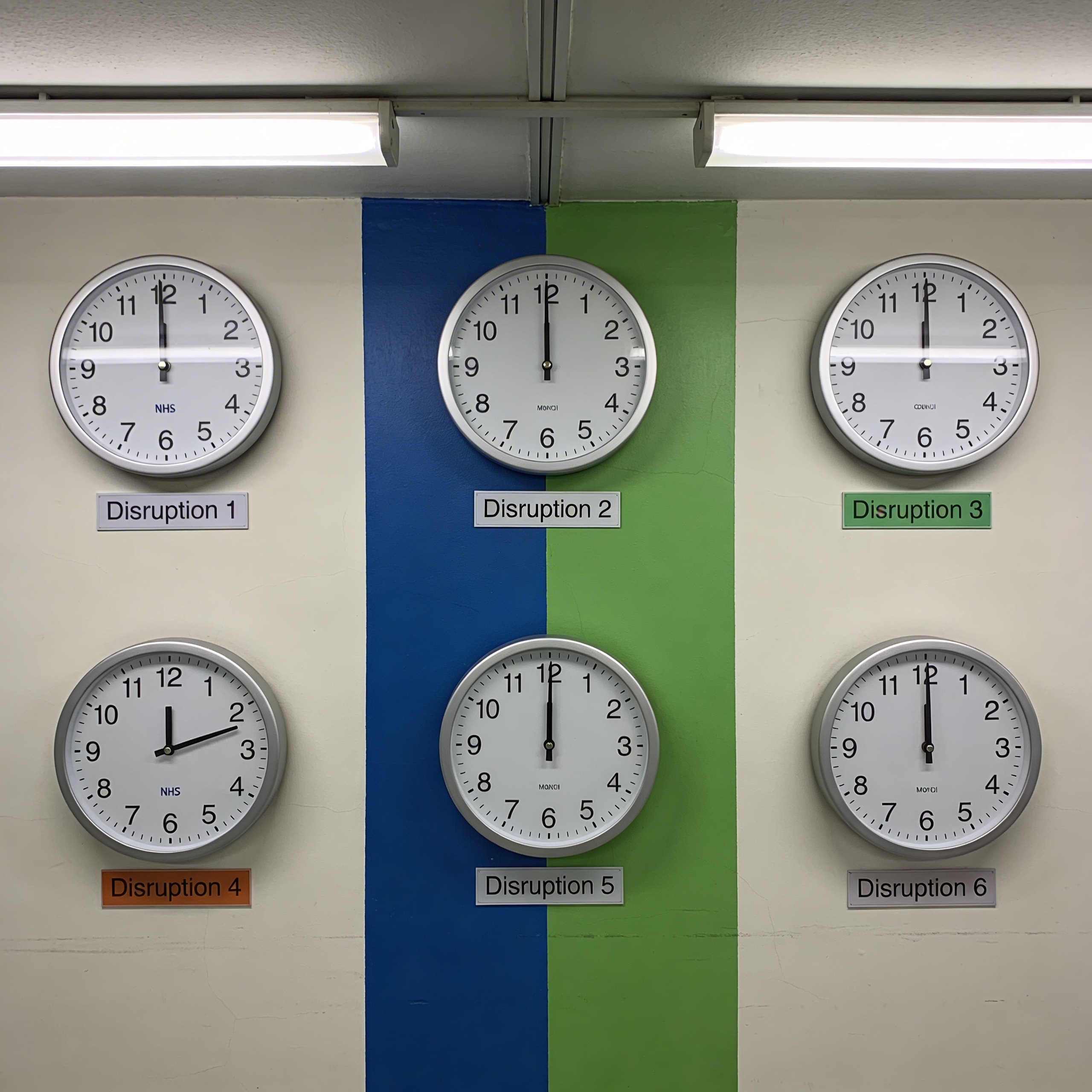
Key Takeaways
- Six concurrent disruptions are converging on the LA–NHS boundary within twenty-four months: local government reorganisation, ICB mergers, neighbourhood health implementation, the Casey Commission, CQC local authority assessments, and BCF reform combined with the Data Use and Access Act.
- When organisations dissolve, boundary governance expires — Section 75 agreements, BCF plans, Safeguarding Adults Boards, CHC procedures, and data-sharing agreements do not transfer, they terminate, because they were made between specific legal entities that cease to exist.
- No previous period has seen this many disruptions on the same boundary simultaneously. The boundary is being destabilised, newly demanded, externally assessed, systemically reviewed, financially reformed, and legally reframed all within the same window.
- Organisations that commission a Seven Flows audit before reorganisation carry a maturity map, transfer specification, CQC-ready evidence base, and neighbourhood health readiness assessment through every disruption. Organisations that wait rebuild from scratch — for the third or fourth time in a generation.
- The boundary is permanent. The infrastructure should be too. The constitutional domain gap has survived every reorganisation since 1948. Only governance infrastructure attached to the crossing — not the organisations — survives when structures change.
Series: This is the final article in the LA–NHS Constitutional Boundary series. The first article established the constitutional domain gap. The second mapped the simultaneous reorganisation of both sides. The third quantified the £2.6 billion annual cost of delayed discharge. The fourth revealed the data infrastructure asymmetry. The fifth showed why neighbourhood health depends on boundary governance. The sixth examined why every accountability mechanism finds the same failures. The seventh applied the Seven Flows methodology to the crossing in full. This article examines why the next twenty-four months are the window — and what happens to organisations on each side of it.
This series has made one argument in seven different ways: the boundary between local authority social care and the NHS lacks governed infrastructure, and everything that depends on that boundary — discharge, safeguarding, neighbourhood health, continuing healthcare, data sharing, accountability — fails in predictable and documented ways because of it.
That argument is structural. It does not depend on timing. The constitutional domain gap has existed since the National Assistance Act 1948 separated health from social care. It has survived every reorganisation, every integration initiative, every commission, and every policy framework since. The boundary is permanent. The question has never been whether it needs governed infrastructure. It has been when.
The answer is now. Not because the argument has changed, but because six concurrent disruptions are converging on the same boundary within the same twenty-four-month window — and each one will either build on governed infrastructure or build from scratch.
Risk 1: Local Government Reorganisation — Section 75 Agreements Expire on Dissolution
Twenty-one two-tier areas are reorganising into unitary authorities. Surrey’s new unitary goes live in April 2027 after the ICB merger in April 2026 — six months of an ICB partnering with councils it knows will cease to exist. Across England, county councils and district councils are submitting competing proposals for new structures, with Devolution Priority Programme areas expected to move fastest.
When a local authority dissolves, its Section 75 agreements with NHS organisations terminate. Its Better Care Fund plans lose their legal home. Its Safeguarding Adults Board is dismantled. Its CHC procedures, data-sharing agreements, and discharge protocols expire — not transfer, expire — because they were made between specific legal entities that cease to exist.
Every boundary governance arrangement built between the old council and the local NHS is lost. Every relationship, every workaround, every informal understanding that made the ungoverned crossing tolerable. The Health Foundation documented this pattern in previous reorganisations — institutional memory carried by people not systems, lost when structures change.
First-mover position: An organisation that has mapped its boundary governance infrastructure — identifying which crossings are governed by transferable infrastructure and which depend on relationships with the current counterparty — can design the transfer to successor organisations before dissolution. An organisation that has not mapped it will discover what it has lost only after the crossing fails in the new structure.
Risk 2: ICB Mergers — Every LA Boundary Arrangement Rebuilt
NHS England is pursuing coterminosity — aligning ICB boundaries with local authority boundaries. This means merging the current 42 ICBs into fewer, larger bodies. Several mergers are already underway or announced. Each merger creates a new NHS organisation that must re-establish every boundary arrangement with every local authority in its footprint.
The mergers are happening before LGR decisions are finalised. An ICB merging in 2026 may be establishing boundary arrangements with councils that will dissolve in 2027. The new ICB must build relationships with counterparties it knows are temporary — and then rebuild again with the successor unitaries.
First-mover position: An ICB that has conducted a Seven Flows audit of its LA boundaries before merger carries a structured understanding of what governance exists and what is absent into the new organisation. It can identify which boundary arrangements transfer (infrastructure) and which are lost (relationships). An ICB that has not audited its boundaries merges blind — discovering only afterwards which crossings work in the new structure and which have silently broken.
Risk 3: Neighbourhood Health Implementation — Continuous Crossing Required
The 43 wave 1 sites launched in September 2025 with new voluntary contracts from 2026. Single neighbourhood providers serving 30,000–50,000 people, multi-neighbourhood providers serving up to 250,000 — all requiring the LA–NHS boundary to work continuously, not episodically. The 10 Year Health Plan positions neighbourhood health as the centrepiece of the “left shift” from hospital to community.
The fifth article demonstrated that neighbourhood health makes structural demands of the boundary that co-location cannot satisfy: shared identity across domains, governed consent for continuous cross-domain sharing, provenance tracking on integrated care records, explicit responsibility transfer for every escalation, and outcome data flowing back across the boundary. None of the four enabler groups (data/digital, finance, estates, workforce) addresses the boundary as a systemic governance challenge.
First-mover position: A neighbourhood health site that has audited its boundary governance before operational launch knows exactly where the crossing infrastructure exists and where it relies on goodwill. It can build the governed mechanisms that the Nuffield Trust’s analysis says a decade of integration attempts has failed to produce. A site that launches without auditing its boundary joins the long history of integration initiatives that achieve early enthusiasm and then stall at the crossing.
Risk 4: Casey Commission Phase 1 — Recommendations Arriving at Level 0
The Casey Commission’s Phase 1 report is due in 2026. It will set out recommendations for medium-term reform of adult social care, with Phase 2 by 2028 making longer-term recommendations for a “national care service.” The Commission has a broad mandate — national conversation, data-driven deep-dive, tangible solutions implementable over a decade.
Whatever the Casey Commission recommends will require the LA–NHS boundary to function. A national care service requires governed infrastructure between that service and the NHS. Reformed funding requires governed infrastructure for determining which domain pays. Better integration requires governed crossing infrastructure. Better data sharing requires the governed interoperability that the Data Use and Access Act 2025 authorises but does not create.
First-mover position: Organisations that have already mapped and begun building boundary governance infrastructure will be implementing the Casey Commission’s recommendations from a position of structural readiness. Organisations that have not will be starting from the same Level 0–1 maturity that the seventh article documented — and the Commission’s recommendations, however ambitious, will arrive at a boundary that cannot receive them.
Risk 5: CQC Local Authority Assessments — Evidence Not Claims
The CQC is assessing all 153 local authorities within a two-year programme, with a refreshed assessment approach rolling out from 2026. The nine quality statements include “safe systems, pathways and transitions,” “partnerships and communities,” and “safeguarding.” As the sixth article argued, these assess the node rather than the edge — but they assess partnership working as an attribute of the authority, and an authority that cannot demonstrate effective cross-boundary working will score poorly.
Two authorities have already been rated inadequate. Others are investing heavily in preparation. The 2025 ADASS Spring Survey found that many authorities had revised their systems partly in anticipation of CQC assessment. The assessments are driving change — but change focused on node performance rather than edge infrastructure.
First-mover position: A local authority that can show CQC a structured boundary governance assessment — a maturity map across seven flows and six crossing types, with evidence of where governed infrastructure exists and where gaps are being addressed — demonstrates governance maturity that the assessment framework values even if it does not yet explicitly name. The authority is not just claiming good partnership working. It is evidencing governed infrastructure for cross-boundary safety, transitions, and accountability. That is a different conversation with CQC from “we have good relationships with the local NHS.”
Risk 6: BCF Reform and the Data Use and Access Act — Outcomes Without Infrastructure
The Better Care Fund — approximately £9 billion of pooled NHS and local authority funding — is being reformed from 2026–27 onwards, refocused on prevention and admission avoidance. The government has signalled that the reformed BCF will be more closely linked to the 10 Year Health Plan’s objectives and the neighbourhood health model. Simultaneously, the Data Use and Access Act 2025 makes information standards mandatory for providers and IT suppliers — but Schedule 15 and Section 121 lack commencement dates, specific standards remain to be defined, and the cost pass-through problem (IT suppliers incurring compliance costs under existing contracts) remains unresolved.
Together, these create a dual pressure: funding reform that demands measurable cross-boundary outcomes, and data governance legislation that provides legal authority for cross-boundary sharing but not the infrastructure to execute it. The BCF reform will ask: is pooled funding producing better outcomes across the health-social care boundary? Without governed outcome flows — the most structurally absent of the seven flows, Level 0 for most crossing types — that question cannot be answered.
First-mover position: Organisations that have built outcome infrastructure at the boundary — bidirectional flows that close the loop across the crossing — can demonstrate to BCF governance and DHSC that pooled funding is producing measurable cross-boundary results. Organisations that have not built outcome infrastructure cannot answer the question, regardless of how much money flows through the pooled budget.
The 24-Month Convergence Window
Six disruptions. Each from a different direction. Each with a different governance body, a different timeline, and a different statutory basis. But mapped onto the LA–NHS boundary, they all arrive at the same point: the ungoverned crossing between constitutional domains.
| Disruption | Timeline | What it demands of the boundary |
|---|---|---|
| LGR | 2026–2028 | Transferable governance that survives dissolution |
| ICB mergers | 2026–2027 | Boundary map that carries into new organisation |
| Neighbourhood health | 2025–2028 | Continuous governed crossing, not episodic |
| Casey Commission | Phase 1: 2026 | Structural readiness to implement recommendations |
| CQC LA assessments | 2024–2026 | Evidence of governed partnership, not just claimed |
| BCF reform + DUAA | 2026–2027 | Measurable cross-boundary outcomes |
No previous period has seen this many concurrent disruptions converging on the same boundary. LGR and ICB mergers are dissolving the organisations on both sides. Neighbourhood health is demanding continuous crossing. The Casey Commission is redesigning the system. CQC is assessing how well it works. BCF reform is demanding evidence that it produces results. And the DUAA has provided legal authority for data sharing without the infrastructure to execute it.
Each disruption is manageable in isolation. Together, they create a twenty-four-month window in which the LA–NHS boundary will be simultaneously destabilised (reorganisation), newly demanded (neighbourhood health), externally assessed (CQC), systemically reviewed (Casey), financially reformed (BCF), and legally reframed (DUAA).
Organisations that enter this window with governed boundary infrastructure carry it through. Organisations that enter without it will spend the window rebuilding from scratch — for the third or fourth time in a generation.
Six Disruptions, One Boundary, Twenty-Four Months
Every disruption demands governed infrastructure at the LA–NHS crossing. Organisations that build it now carry it through. Organisations that wait rebuild from scratch — again.
25
25
25
25
26
26
26
26
27
27
27
27
28
28
28
28
health43 wave 1 sites
CommissionPhase 1 + 2
assessments153 authorities
+ DUAA£9bn + standards
Diagram: Six disruptions converging on the LA–NHS boundary. Timeline showing LGR, ICB mergers, neighbourhood health, Casey Commission, CQC LA assessments, and BCF reform + DUAA all landing within a 24-month convergence window. Six disruption cards showing what each demands and the first-mover position. Two-path comparison: build now and carry through vs wait and rebuild from scratch.
Pattern from Previous NHS Reorganisations
This is not the first time the LA–NHS boundary has been reorganised. PCTs became CCGs in 2013. CCGs became ICBs in 2022. Each time, the institutional memory at the boundary — the relationships, the workarounds, the informal agreements — was carried by people rather than systems. Each time, it was lost when the people moved on or the organisations changed. Each time, the new structures spent their first years rebuilding the boundary arrangements that the old structures had taken years to develop.
The second article documented this pattern in detail. What is different this time is not the pattern but the scale: both sides are reorganising simultaneously, under conditions where the boundary is under more operational pressure (neighbourhood health, BCF reform) and more regulatory scrutiny (CQC, Casey) than at any previous point.
The organisations that broke this pattern — that carried boundary governance through previous reorganisations intact — were those that had invested in infrastructure rather than relationships. Not instead of relationships. In addition to them. Infrastructure does not replace the people who make crossings work. It ensures that what they build is encoded in systems that survive when they leave, when organisations change, and when the administrative geography is redrawn.
What Building Before Reorganisation Delivers
A local authority that commissions a Seven Flows audit before reorganisation gets:
A maturity map showing which crossings are governed by infrastructure (transferable to successor organisation) and which depend on relationships with the current NHS counterparty (at risk of loss on reorganisation). This is the diagnostic that determines what must be built before dissolution and what can wait.
A transfer specification identifying the boundary governance infrastructure that the successor unitary authority needs to inherit — the governed crossings, the data-sharing infrastructure, the responsibility transfer protocols, the outcome flows — documented in a form that can be handed to the new organisation’s leadership on day one.
A CQC-ready evidence base demonstrating governed partnership working — not just good relationships, but infrastructure for safe systems, pathways, and transitions across the constitutional boundary. This serves both the current assessment programme and any future assessment by the CQC under reformed frameworks.
A neighbourhood health readiness assessment for any site within the authority’s footprint, showing where the boundary governance infrastructure exists to support continuous integrated care and where it must be built before the neighbourhood model can deliver what the policy framework promises.
An ICB that commissions a Seven Flows audit before merger gets the same: a structural understanding of which boundary arrangements transfer and which are lost, a specification for what the merged organisation needs at the boundary, and evidence of governed cross-boundary working for CQC and DHSC.
The cost of the audit is a fraction of the cost of rebuilding boundary arrangements from scratch after reorganisation. The cost of not auditing is measured in the metrics this series has documented: £2.6 billion in delayed discharge, 72% of SARs finding poor coordination, 80.5% of CHC assessments rejected, sixfold variation in eligibility, and outcome loops that never close.
The LA–NHS Boundary: The Argument in Eight Articles
Eight articles. One boundary. One argument.
The LA–NHS boundary is the most complex crossing in English public services. It spans two constitutional domains — the NHS Act and the Care Act — with different legislation, different funding, different data architecture, different professional frameworks, and different accountability regimes on each side. It is being reorganised on both sides simultaneously. It costs billions of pounds in delayed discharge, contested CHC determinations, and fragmented care. It is the point where safeguarding fails, where neighbourhood health stalls, and where every accountability mechanism finds the same problems without building the infrastructure to solve them.
The Seven Flows — Identity, Consent, Provenance, Clinical Intent, Alert and Responsibility, Service Routing, and Outcome — define what governed infrastructure must do at this crossing. The maturity framework shows where infrastructure exists (almost nowhere above Level 2) and where it is absent (almost everywhere for outcome flows, safeguarding, and clinical escalation from social care). The critical gap is between Level 2 (process that depends on people) and Level 3 (infrastructure that survives organisational change).
Six concurrent disruptions are converging on this boundary within twenty-four months. Each demands governed infrastructure that does not yet exist. The organisations that build it now will carry it through reorganisation, demonstrate it to CQC, use it to implement the Casey Commission’s recommendations, and measure the cross-boundary outcomes that BCF reform requires. The organisations that wait will rebuild from scratch — again — and will spend the next three to five years re-establishing the informal arrangements that the reorganisation destroyed.
The boundary is permanent. The infrastructure should be too.
This is the final article in the LA–NHS Boundary Series. For organisations considering a Seven Flows boundary governance audit, contact Inference Clinical or visit the Seven Flows methodology page.
Assess your boundary governance readiness: Inference Clinical’s Boundary Risk Assessment evaluates governance at every organisational crossing — including each of the six disruptions described in this article. Start with a Boundary Risk Score to see where your LA–NHS boundary stands before reorganisation.
LA–NHS Constitutional Boundary — Complete Series
- #1 The Most Complex Boundary in English Healthcare
- #2 The Great Reorganisation: Every Boundary Redrawn at Once
- #3 Delayed Discharge: An Interface Problem, Not a Capacity Problem
- #4 The Data Governance Chasm
- #5 Neighbourhood Health Cannot Work Without Boundary Governance
- #6 Safeguarding, CHC and the Accountability Gap
- #7 Seven Flows at the LA–NHS Boundary
- #8 Building Before the Reorganisation (this article)
Related Series
- Architecting Neighbourhood Health — 10 articles on boundary governance in NHS neighbourhood teams
- Private Healthcare Governance — 8 articles on boundary governance in insured care
- Healthcare Boundary Governance — 4 articles on why organisational boundaries are the blind spot in NHS reform