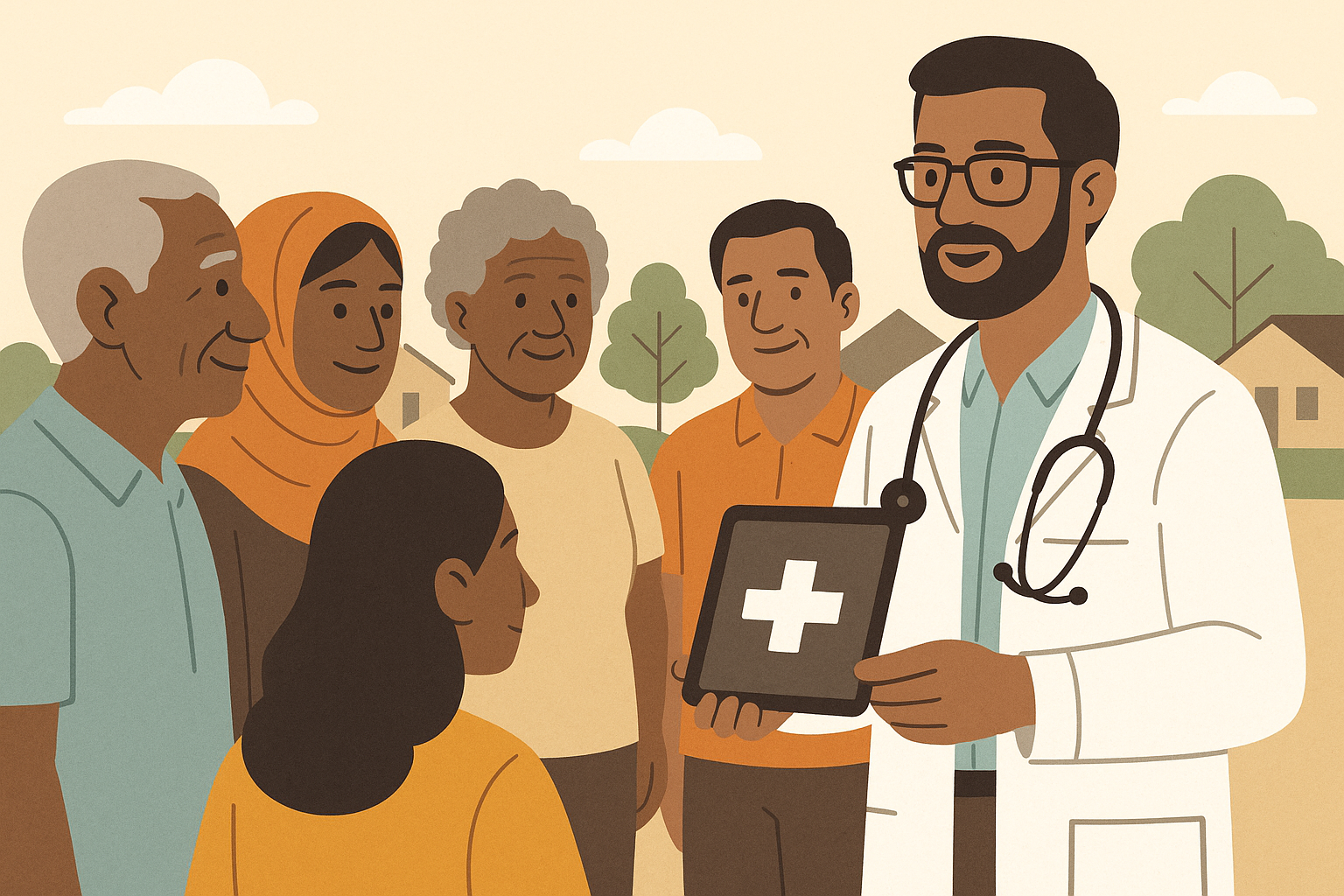
The sun has barely cleared the clinic roof when a community nurse in a rural district pulls out her tablet. The connection is weak again, but the blood-pressure readings from yesterday's home visits are still there—saved locally, ready to sync when the signal returns. One patient withdrew consent to share data with the hospital; another added a caregiver to her record. None of it depends on a distant server. The nurse is working inside her own small, trusted digital space.
That moment captures the tension shaping the future of healthcare technology: care that is personal and local, yet must still connect safely to the larger system.
From Central Systems to Local Stewards
For the last decade, digital health has been built around central systems—national data stores, enterprise EHRs, analytics hubs. They are essential for oversight and continuity, but they don't reflect how care actually happens: through relationships, improvisation, and trust built face to face.
Community-led healthcare depends on flexibility—the ability to adapt workflows to culture and circumstance, to integrate social context, to keep working when the internet doesn't. But flexibility without shared standards becomes fragmentation. That's where FHIR—the Fast Healthcare Interoperability Resources standard—offers a path forward.
FHIR is often described as an "API for healthcare," but it's really a grammar for representing the data, decisions, and consents that make up care. And like any grammar, it can be spoken with a local accent without losing meaning.
FHIR at the Edge
A FHIR cube (a self-contained local data store) brings this grammar closer to where care happens. Think of it as a compact, portable FHIR engine that can run on a mobile device, a clinic workstation, or a small community server. It stores patient data in FHIR format, syncs selectively with cloud systems, and supports local workflows even when offline.
But the value of the cube isn't technical—it's social:
Autonomy with alignment: A community can adapt its care protocols or social data models without waiting for a central IT change request, while staying interoperable by design.
Trust anchored in transparency: Every observation, consent, and plan carries provenance. People can see who accessed what and why.
Safety without surveillance: Clinical safeguards and consent checks run locally, not through distant approval.
It's not decentralization for its own sake; it's federated responsibility. Each community becomes a steward of its digital health commons.
Trust Is the Real Infrastructure
Technology only enables community-led care if people trust it. Trust doesn't come from branding or compliance—it comes from transparency: knowing that the system enforces the same ethics we expect from clinicians.
FHIR provides that scaffolding.
Mutual authentication ensures only verified devices and practitioners connect.
Consent resources make patient choice explicit and machine-readable.
AuditEvents record every access with purpose and timestamp.
For example, when a community health worker in northern Kenya retrieves a patient record, the local cube logs the action against the specific consent that patient gave at last week's visit. The entry appears in both the worker's audit log and the patient's own record—a small but vital act of digital accountability.
When these capabilities live at the edge, privacy becomes a local practice, not a remote promise.
Flexibility Without Fragmentation
Some policymakers fear that local flexibility undermines data integrity. FHIR's modular design prevents that. It doesn't dictate what care should be—it defines how care data is described and exchanged.
A maternal-health program can add an extension for community birth companions while still syncing encounters, vitals, and referrals into national systems. Flexibility here isn't chaos; it's controlled diversity built on a shared foundation.
A Digital Commons, Not a Digital Colony
For too long, "interoperability" has meant one-way extraction—data flowing out of communities to feed dashboards, rarely returning to improve local care. Community-led healthcare reverses that flow.
When FHIR is used locally, it becomes commons infrastructure: shared, transparent, collectively maintained. Communities can innovate safely while contributing back to the broader ecosystem—new care pathways, terminologies, or population insights.
It's the same principle that built the open web and open science: distributed creativity within a shared framework.
The Human Layer of Interoperability
Technology encodes assumptions about agency. Community-led healthcare demands that digital systems preserve it.
FHIR cubes let communities decide:
- What stays local versus synced to the cloud.
- How consent is checked before data leaves the device.
- Which algorithms govern alerts for their population.
Clinical logic, social context, and consent models all remain close to where care happens. That's not just sound engineering—it's a recognition that dignity and safety are inseparable.
Resilience Through Local Intelligence
During disasters or network outages, centralized systems falter. Clinics need to keep functioning even when disconnected. Local FHIR stores allow them to continue safe, auditable care, then sync once connectivity returns.
The same architecture that supports autonomy in normal times sustains resilience in crisis. Community-led healthcare is resilience made operational.
Where We Go Next
To make healthcare truly equitable, our digital systems must be both standardized and situated: standardized enough to share meaning, situated enough to serve real lives.
FHIR gives us the shared language. Local-first architectures like the cube give us the place to speak it. Together, they can transform health data from a bureaucratic artifact into a living, community asset.
The next phase of digital health innovation won't be about bigger platforms. It will be about smaller systems that know where they belong.
A Gentle Invitation
Community-led healthcare isn't about replacing national systems; it's about completing them. It's about giving every clinician, volunteer, and patient a stake in how digital care works.
If you're building or governing digital health, start small. Let one community lead—and let the rest of us learn from how they care.
Related Reading
-
When the Network Sleeps: Building Trust Into Systems That Can't Always Be Awake →
Resilience and reliability in distributed health data systems
-
From Boardroom to Bedside: Distributed Health Data Systems That Actually Work →
Why local control and shared standards unlock better care
-
From Data Foundations to Clinical Confidence →
Why quality, availability, and reliability matter for AI in health
Building Community-Led Healthcare Infrastructure?
Learn how we help design local-first, FHIR-enabled systems that preserve autonomy while enabling safe interoperability.
Get in Touch