For executive and management leaders across the NHS and provider organisations.
If you've felt the tension between "we should move faster with AI" and "I need to sleep at night," you're not alone. Most boards now accept that algorithms will sit inside routine clinical workflows. What's less clear is how to govern them without slowing care to a crawl. The uncomfortable truth: a static, document‑based safety case doesn't survive contact with a living service. Models shift, data shifts, people shift. The PDF stays the same.
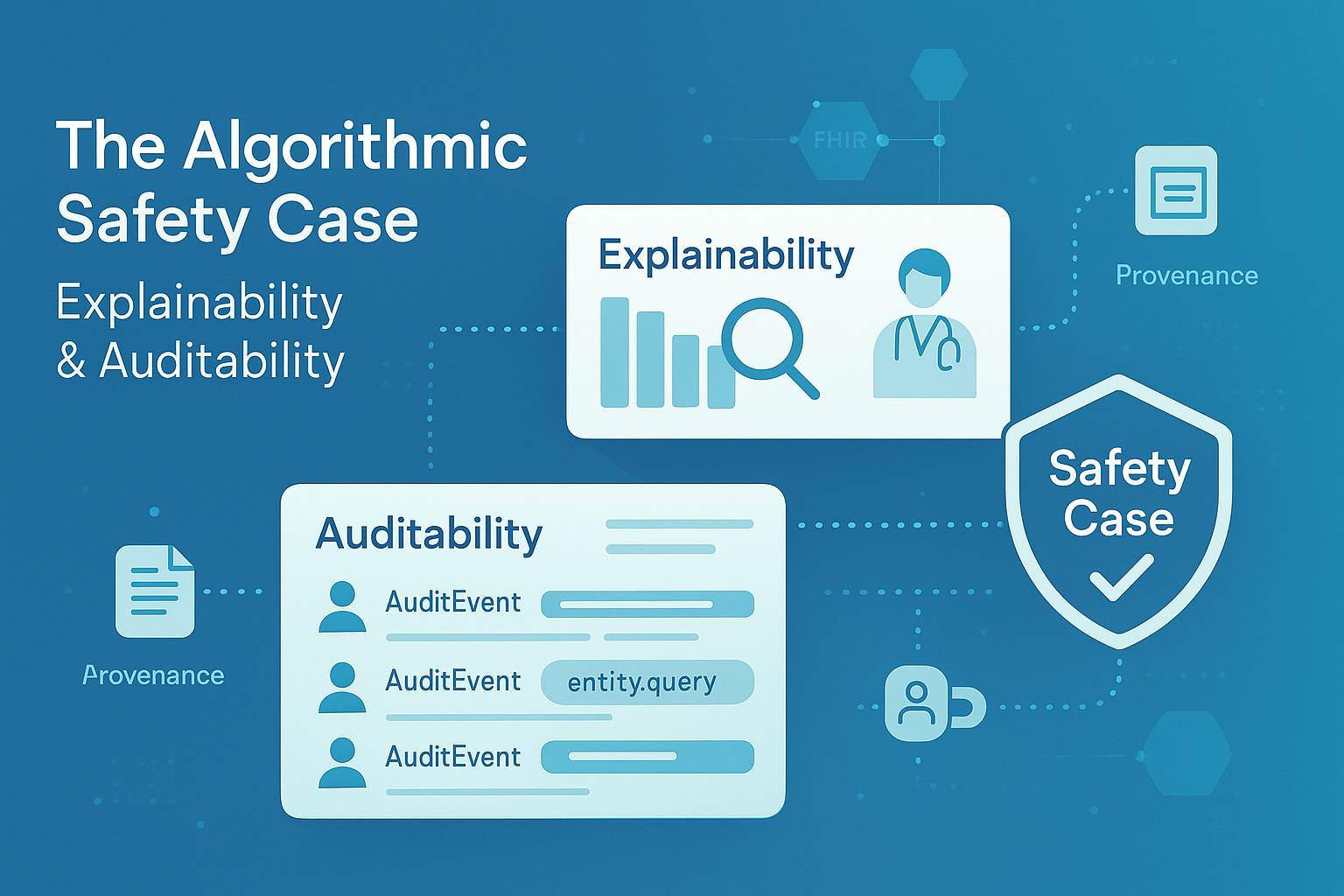
This is where explainability and auditability stop being features and become safety controls. Explainability tells you what the algorithm relied on and how confident it is. Auditability tells you who did what, when, and with which data and model. Together they let you turn the Safety Case from a report into a live control.
The familiar pattern (and why it fails)
Picture a morning huddle. An overnight alert escalated; a clinician made a call; the patient is fine, but the team is uneasy. You ask the reasonable questions: Which model was live? Why did it flag? Who looked at what? Which data were used? You can get the answers—eventually. They live in five systems and three inboxes. By the time you reconstruct the episode, your team has burned weeks and goodwill. That's not negligence; it's a structural issue. The assurance mechanism is offline while the service is online.
From report to runtime
The Algorithmic Safety Case is simply this: the evidence you need to defend a decision is generated as part of the decision, not written up later. At the point of care, the system surfaces the top factors that drove the output—human‑readable and tied to the patient in front of you. Every decision carries a calibrated confidence signal. Low confidence doesn't just look worrying; it changes behaviour—the system downgrades autonomy and asks for a human decision. In the background, we capture the trigger (the query or event that set things in motion), the context (who, where, when), and the lineage (which inputs, which model, which version). If someone overrides the algorithm, that act is recorded as a first‑class safety signal, not lost in a free‑text note.
With that foundation, the Safety Case becomes a living asset. Hazards don't wait for a quarterly review: signals from the field—uncertainty spikes, clusters of overrides, subgroup performance shifts—automatically update the Hazard Log and prompt the Clinical Safety Officer when thresholds are breached.
What your teams actually see
Clinicians don't get a maths lecture. They see a simple card: the recommendation, the top reasons ("ECG variability and HR spike in last 30m"), and a confidence gauge. If the gauge is low, the UI slows them down and asks for a review. Safety officers don't trawl log files; they open a replay view that shows the query that fired, the inputs involved, the model version that ran, the explanation that was shown, the confidence at the time, and any override—all timestamped and attributable. Engineers and informaticians don't reinvent governance on every release; they ship with the evidence bundle attached.
Why regulators will like it (and your clinicians will too)
Across the UK, EU and US, the direction of travel is the same: transparency, lifecycle monitoring, and the ability to contest a machine's output. A living Safety Case doesn't add ceremony; it removes rework. It creates the professional confidence to use AI in routine care because it answers the question every clinician will ask at some point: "Can I see why it said that, and can I challenge it safely?"
What changes on Monday morning
The practical impact is easy to recognise:
- Approvals speed up because each release arrives with its own evidence: explanation, confidence, lineage, and change notes. The Safety Case is current by design.
- Investigations get cheaper because you can reconstruct an episode in minutes, not weeks.
- Accountability gets cleaner because each party—manufacturer, deploying organisation, clinician—has the evidence they need to make and defend decisions.
How we make it real (without ripping out your EHR)
We designed the platform to work alongside Epic, Cerner/Oracle Health and others.
- DCB CoLab turns the Safety Case and Hazard Log into a workflow. Releases don't pass CI/CD gates without the right evidence and, where needed, CSO sign‑off. Overrides from the ward flow back as signals—not anecdotes.
- FHIR Cube is the backbone for audit and lineage. We log the trigger—the query and the who/when—as standard FHIR AuditEvent. We attach Provenance to every AI‑created or modified clinical record so you can trace which data were used, which model/device version ran, and in what context. Pulling an "evidence bundle" for a single decision becomes a one‑click job.
- SteadyTrace brings confidence into the open. Streaming data from wearables and devices get a reliability score; model outputs get a confidence score. Those numbers aren't decorative—they gate autonomy. Below threshold? The system slows down and calls for a human.
- HealthFoundry insists on Model Cards for every algorithm: intended use, metrics (including subgroup performance), limitations, explainability methods, uncertainty approach, and change history. When someone asks "what changed?", you don't need a war room to answer.
Two simple stories
Remote monitoring. A patient on a cardiac pathway triggers a night‑time alert. Confidence comes in at 0.56—borderline signal quality and a pattern we haven't seen much locally. Autonomy drops automatically; a clinician reviews with the context in view. They see the top factors ("nocturnal HR variability ↑; missed readings yesterday; motion artefact"), the data that fed the decision, and the model version that ran. They decide it's a false positive—sensor slip. Their override is captured, and similar cases are clustered for the safety team to review. No witch‑hunt, no spreadsheets; just learning.
Post‑release change. An image‑analysis model is updated under a predefined change plan. Sensitivity improves overall; specificity dips in one subgroup. The Model Card and release notes make that trade‑off explicit; the confidence threshold for the subgroup is raised accordingly. DCB CoLab won't deploy the change until the Safety Case chapter is updated and the CSO signs it off. If a question arises later, the team can show exactly which version was live, who saw what, and why the system behaved as it did. That's governance you can defend in a board pack and at the bedside.
What good feels like
Leaders shouldn't have to count the number of PDFs to gauge safety. Instead, you start to see operational signals:
- time to reconstruct a decision drops to minutes;
- almost every AI decision on record carries its explanation, confidence, query and provenance;
- overrides are rare—and when they happen, they teach you something (bias, drift, design, training);
- hazards are acknowledged quickly and closed with evidence, not email threads;
- releases stop queuing behind paperwork because the paperwork is generated by the release.
Roles stay the same—evidence changes the conversation
Your Clinical Safety Officer still owns the Safety Case in live service; they just have live signals and a clear replay. Product and clinical engineering still own build quality; they just ship explanations and confidence by default. Operations and InfoSec still own the perimeter; they just get clean coverage of who did what and when. And the Executive Sponsor still sets the policy on autonomy (what must be reviewed, what can be automated), but now those policies are enforced by code, not memory.
Where to start (and how to keep it calm)
Pick one pathway with engaged clinicians and measurable outcomes—diabetes remote monitoring is usually a good fit. Stand up CoLab, wire FHIR Cube for audit and lineage, expose explanations and confidence, agree the thresholds, and run a tabletop incident drill before go‑live. In eight weeks you should be able to show: decision reconstruction in minutes; evidence coverage above 99%; hazard acknowledgements within a day; and a reduction in false escalations. That's the kind of improvement that convinces both a CSO and a CFO.
The payoff
Adopting the Algorithmic Safety Case doesn't mean more paperwork—it means less. Evidence is generated automatically where care happens. Clinicians see the "why" and "how sure" at the moment of decision. Lineage and access are logged without debate. Hazards update themselves when the field tells you something has changed.
For executives, this translates into fewer surprises, cleaner public accountability, faster time‑to‑impact for digital programmes, and a credible path to scale AI safely across services.
Bottom line: if you want AI to be clinically useful at scale, make explainability and auditability part of the product, not the report.
Ready to Transform Your AI Safety Approach?
Learn how Inference Clinical can help you operationalise continuous assurance for your clinical AI systems.
Get in Touch