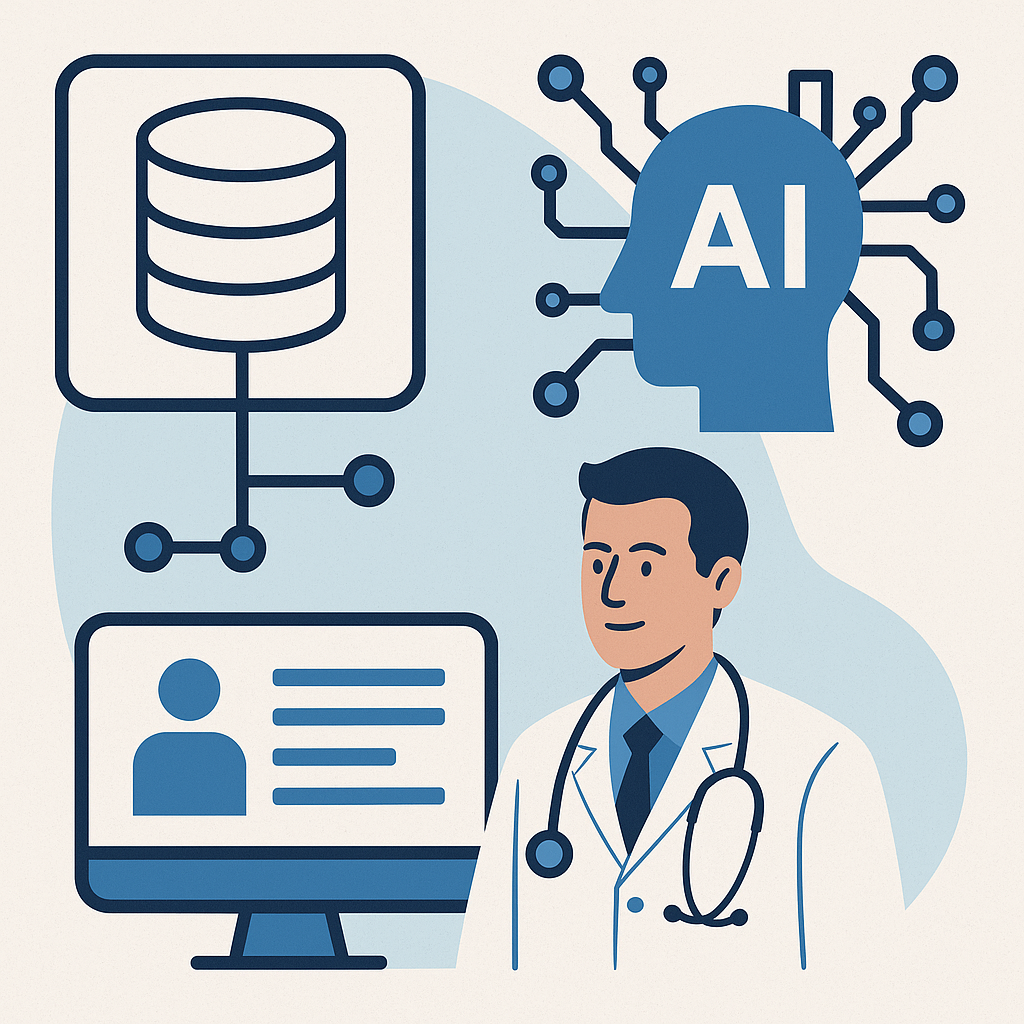
Building the Business Case: Flexible, Distributed, Patient-First Data Architectures
If data quality, provenance, and availability are the conditions for trusted AI, the architecture that carries this data is the enabler of scale and sustainability. Today's monolithic health IT systems struggle to keep pace with the demands of multi-site care, consumer health data, and AI-driven insights. What's needed is a flexible, distributed, and interoperable architecture that starts with the patient.
Why Patient-First?
Single Anchor of Truth: The patient record becomes the centre of gravity, reducing duplication and "multiple truths."
Continuity Across Settings: From GP to hospital to home monitoring, data flows with the patient rather than being trapped in institutional silos.
Patient Agency: Patients can contribute their own validated data (wearables, diaries, PROMs), enriching the clinical picture.
Why Distributed?
Resilience: Data doesn't rely on one central node; it is available at the edge and in the cloud. See how we build trust into systems that can't always be connected →
Performance: Clinicians access data locally without waiting on central servers.
Scalability: New nodes and data sources can be added without wholesale system redesign.
Why Interoperable?
Standards-based: Built on FHIR, SNOMED CT, dm+d, and UK Core profiles.
Plug-and-Play Innovation: Startups and NHS teams can integrate new tools without costly, bespoke interfaces.
Regulatory Alignment: Data that already travels in the right standards simplifies compliance and safety assurance.
FHIR Cube: A Foundation for Innovation and Trust
At Inference Clinical, we see FHIR Cube as the building block of this architecture. It's a patient-anchored, distributed FHIR datastore designed for:
Local Control – Each patient device or edge node carries a coherent FHIR dataset, synchronised with central services.
Provenance-Preservation – Metadata and audit trails are baked in, ensuring every data point carries its context.
Interoperability – Standards-compliant by design, so data can flow across care settings and into AI pipelines.
Safety-by-Default – Hooks into hazard detection, validation, and governance workflows.
The business case is clear:
- For clinicians: trusted, explainable AI backed by reliable data.
- For innovators: a stable, standards-based platform to build on.
- For the NHS: reduced duplication, lower integration costs, and faster assurance through transparent data lineage.
- For patients: continuity of care, greater agency, and safer innovation.
Conclusion
Data quality, provenance, and reliability aren't abstract technical ideals — they are the enablers of real clinical confidence. But to realise them at scale, we must move from fragmented, siloed infrastructures toward flexible, distributed, patient-first architectures.
By anchoring the health system's data model at the level of the patient, and ensuring that every datum carries provenance and context, we build the trust fabric that allows AI to become not just experimental but dependable.
FHIR Cube is a step toward that vision: a foundation for interoperable, safety-aligned innovation that starts where it should — with the patient.
Related Reading
-
Building Distributed Health Data Systems: What Buyers Need to Know →
A comprehensive guide for evaluating distributed health data architectures
-
Why Explainability and Auditability Are Now Non‑Negotiable in Clinical AI →
How FHIR Cube provides the audit backbone for trusted AI systems
-
SteadyTrace: FHIR-Native Device Data Platform →
See FHIR Cube in action for remote patient monitoring
Ready to Build Patient-First Data Architecture?
Learn how FHIR Cube can help you create flexible, distributed, and trusted health data systems.
Get in Touch