In digital health, the past decade has been defined by progress in data capture and exchange. Standards such as FHIR and OMOP have made it possible to share clinical records, integrate wearables, and bring research closer to the realities of patients' daily lives.
But the next decade will be defined by something different. As artificial intelligence becomes central to discovery, safety evaluation, and regulatory science, platforms will be judged not only on what data they hold, but on how ready that data is for AI use.
This shift raises a simple but overlooked question:
👉 Is your platform preparing data in a way that enables safe, explainable, and regulatory-grade AI?
The New Currency: Provenance, Context, and Harmonisation
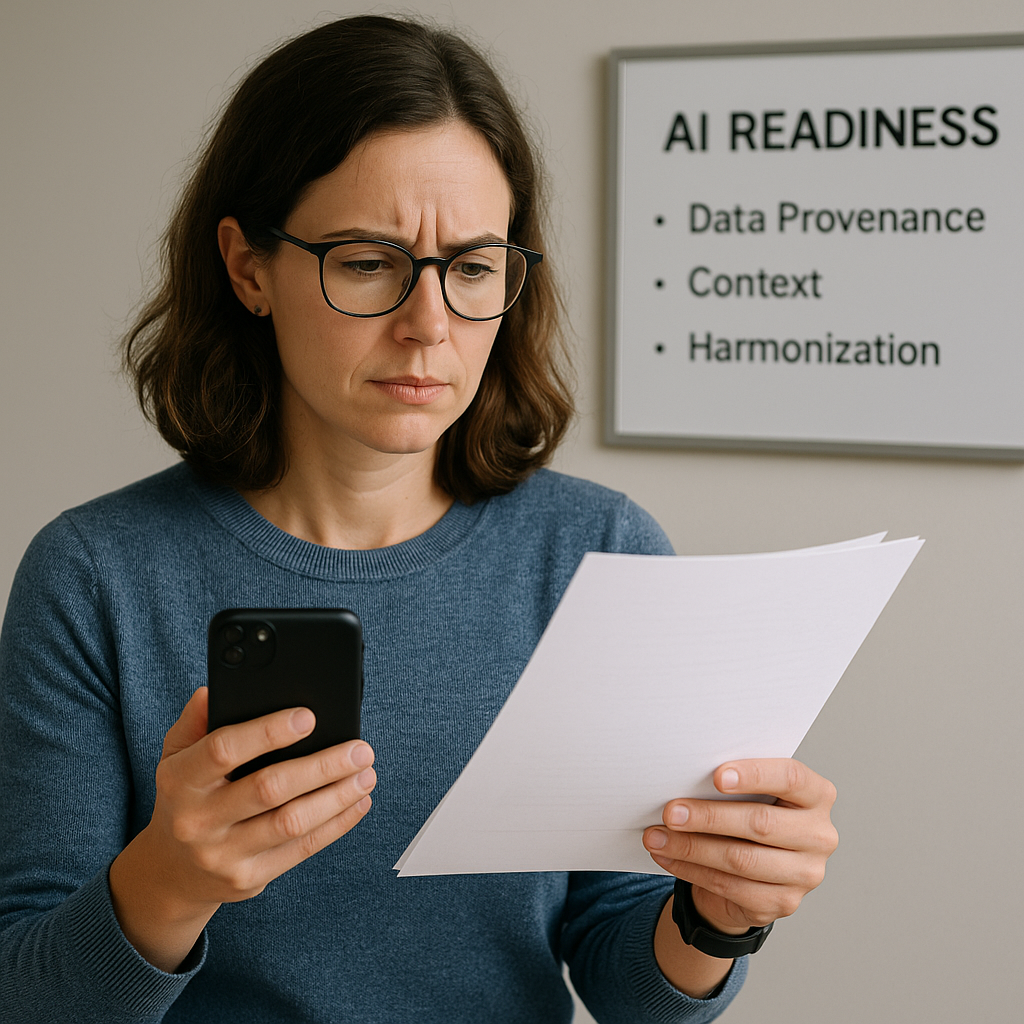
Most health platforms today act like warehouses: data come in, are standardised just enough to move between systems, and then sit until called upon. That may suffice for reporting or interoperability, but it is not enough for AI.
AI models require:
Provenance: knowing exactly where data originated and how it was transformed.
Context: understanding the device, conditions, or patient behaviour behind the signal.
Harmonisation: aligning signals across devices, time windows, and clinical records without months of manual wrangling.
Without these, AI results may look convincing but collapse under scrutiny.
The Risks of Ignoring AI Readiness
Consider a cardiovascular research group testing an AI model to predict atrial fibrillation (AF) risk using smartwatch, mobile app, and electronic health record (EHR) data.
The AF Risk Prediction Study
At first glance, the dataset looked rich:
- Heart rate variability from wearables
- Step count and sleep duration from mobile apps
- Clinical diagnoses, ECGs, and medication histories from the EHR
But because the platform was not designed with AI readiness in mind, subtle cracks appeared:
- A smartwatch firmware update mid-study changed how heart rate variability was calculated — with no provenance metadata to flag it.
- Step data arrived in inconsistent time zones depending on device settings, but the system did not harmonise timestamps.
- AF diagnoses were coded differently across sites, without standardisation.
When the AI model was trained, results looked strong. Yet the model was not simply learning patient risk — it was also "learning" firmware quirks and timestamp errors.
The consequences came later: when the research group submitted their model for regulatory evaluation, reviewers discovered these integrity gaps. The submission was rejected. Months of work and millions in funding were lost — not because the science was weak, but because the data foundations were not trustworthy.
What AI-Ready Platforms Would Change
An AI-ready platform would have prevented this scenario.
- Provenance metadata would have exposed the firmware update.
- Native harmonisation would have aligned signals across time zones.
- Standardised coding at ingestion would have ensured consistency across sites.
The difference is stark: instead of rejection and wasted effort, the group could have presented a defensible, reproducible model with confidence.
Why AI Readiness Belongs in RFIs and RFPs
When organisations issue RFIs or RFPs for digital health platforms, the focus is often on data capture, API availability, and compliance. These matter — but they do not tell the full story.
The differentiator for the next wave of research infrastructure will be AI readiness. Asking whether a platform has thought about provenance, harmonisation, and regulatory defensibility separates those building for today from those building for the future.
Questions worth asking include:
- How does the platform capture and retain provenance metadata?
- Can it harmonise signals across devices and modalities without heavy ETL?
- Is the data model designed to support reproducibility of AI datasets for regulatory submission?
- How much time does it save researchers in preparing AI-ready datasets?
These questions may seem advanced today — but they will be baseline requirements within a few years.
Final Thought
AI in healthcare will rise or fall not on model design, but on data readiness. Platforms that anticipate this — embedding provenance, context, and harmonisation into their core — will accelerate research and withstand regulatory scrutiny. Those that do not will leave researchers patching gaps at the worst possible moment.
In short: interoperability was yesterday's differentiator. AI readiness is tomorrow's.
Related Reading
-
From Data Foundations to Clinical Confidence →
Why quality, availability, and reliability matter for AI in health
-
Why Explainability and Auditability Are Now Non‑Negotiable in Clinical AI →
Building trust through transparency and evidence
-
When the Network Sleeps: Building Trust Into Systems That Can't Always Be Awake →
Resilience and reliability in distributed health data systems
Building AI-Ready Health Data Platforms?
Learn how we embed provenance, harmonisation, and regulatory readiness into research infrastructure.
Get in Touch